


Quick Answer
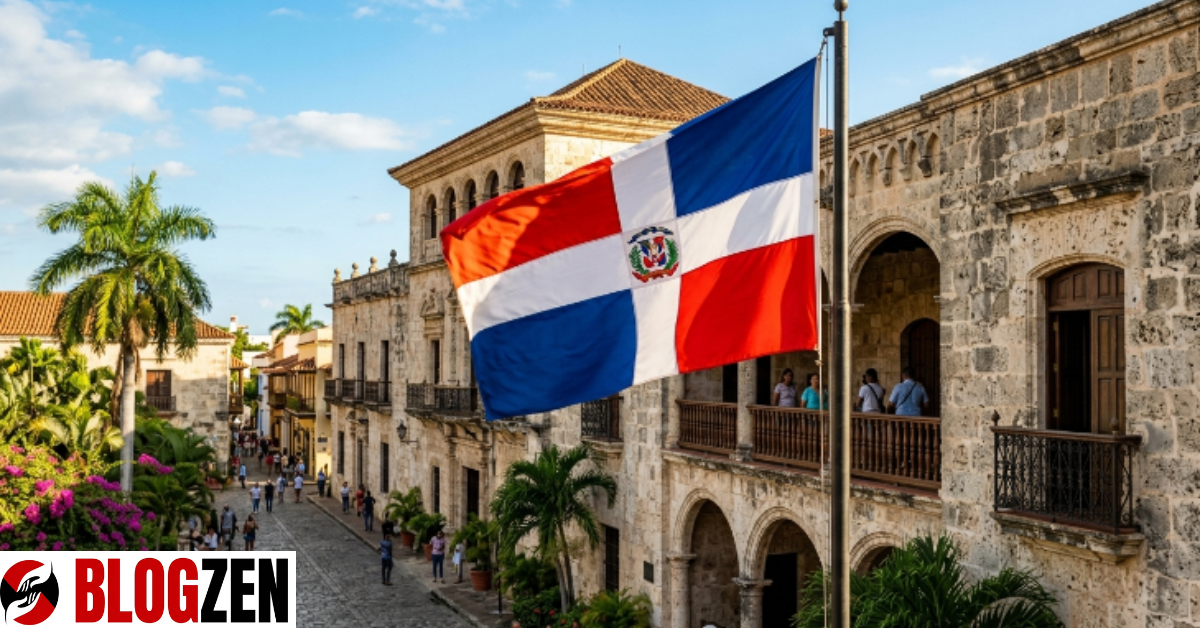
The Dominican Republic flag features a centered white cross dividing four rectangles (blue, red, blue, red) and a coat of arms in the center. The cross represents Christianity, the colors symbolize independence and sacrifice, and it’s the only national flag with a bible in its coat of arms. It was adopted in 1844.
INTRODUCTION
Most people think flags are just pretty designs with colors and symbols thrown together — but the Dominican Republic flag tells a different story entirely. Here’s what makes it remarkable: it’s the only national flag in the world that features a Bible in its coat of arms, and that detail alone reveals an entire nation’s identity and values.
When you look at the Dominican flag, you’re not just seeing red, white, and blue. You’re looking at centuries of struggle, faith, and independence woven into fabric. The white cross that dominates the design isn’t random either. Every element — from the colors to the positioning of the coat of arms — was deliberately chosen to represent something profound about Dominican culture and history.
This article will show you exactly what each part of the Dominican Republic flag means, why the designers chose these specific elements, and the fascinating history behind this unique national symbol. By the end, you’ll understand why Dominicans take such pride in this flag, and you might even see your own national flag differently. Let’s dive in.
What Is the Dominican Republic Flag and Why It Matters Today
The Dominican flag is the national symbol of the Dominican Republic, a Caribbean island nation that shares the island of Hispaniola with Haiti. Adopted on June 6, 1844 — the same day the nation declared independence from Haiti — this flag represents one of the most important moments in Dominican history.
The design is instantly recognizable: a white cross divides the flag into four rectangles, with blue on the top and bottom, and red on the left and right. At the center, where all sections meet, sits the national coat of arms. That coat of arms is where the Dominican flag becomes truly unique in the world.
Why does this flag matter today? Because it’s more than decoration. For Dominicans at home and scattered across the diaspora (especially in New York, Puerto Rico, and other parts of the United States), this flag represents national pride, cultural identity, and the spirit of independence that defines their nation. When Dominican immigrants display their flag, they’re not just showing patriotism — they’re maintaining a connection to their roots and telling the world about their heritage.
How the Dominican Republic Flag Actually Works: Breaking Down Every Symbol
The Dominican flag isn’t complicated, but each element carries meaning. Let’s decode it.
The White Cross
The white cross that runs vertically and horizontally through the flag represents Christianity and faith. This was a deliberate choice — the Dominican Republic wanted the world to know that faith was central to their national identity. The cross divides the flag into four sections, creating perfect balance and symmetry. Think of it as the spiritual foundation holding the nation together.
The Colors: Blue and Red
The four rectangles created by the white cross alternate between blue and red. Blue represents liberty and independence — the values Dominicans fought for when they broke free from Haiti in 1844. Red represents the blood and sacrifice of those who died fighting for that freedom. In flag terminology, this combination conveys both the hope (blue) and the cost (red) of nation-building.
If you compare this to other Caribbean flags, you’ll notice this color pairing is uncommon. Most flags use similar colors to Spain or France (their colonial history), but the Dominican flag’s specific arrangement is distinctly Dominican.
The Coat of Arms: The Game-Changer
Now we arrive at the element that makes this flag globally unique. At the center of the cross, where all four colors meet, sits the Dominican coat of arms. Inside that coat of arms is a shield that contains an open Bible. This is where the Dominican flag breaks every rule — no other country’s flag features a Bible as its primary symbol.
The Bible shown is open to John 3:16, which reads: “For God so loved the world that he gave his one and only Son, that whoever believes in him shall not perish but have eternal life.” (You won’t see the actual verse written on the flag, but it’s the symbolic reference.) Above the shield are three golden crowns, representing the three most important cities in Dominican history: Santo Domingo, La Vega, and Concepción de la Vega.
Pro Tip: If you ever visit the Dominican Republic and see the flag displayed in public spaces, look closely at the coat of arms. The detail and craftsmanship show how seriously Dominicans take their flag’s symbolism.
The Historical Story Behind Why the Flag Looks This Way
You can’t fully understand the Dominican flag without knowing the context of 1844. Picture this: The island of Hispaniola had been colonized, enslaved, and divided for centuries. The western side (now the Dominican Republic) was under Spanish rule, while the eastern side (now Haiti) had successfully rebelled and gained independence.
Then, something remarkable happened. On February 27, 1844, Dominican independence leader Juan Pablo Duarte and his secret society called La Trinitaria declared independence — not from Spain, but from Haiti, which had unified the entire island in 1822 under Haitian rule. This was a unique moment in Caribbean history.
The flag they created needed to convey something specific: We are independent, we are faithful, and we are willing to pay any price for freedom. The cross symbolized the Catholic faith that defined Dominican culture and distinguished them from Haiti. The colors told the story of what independence required.
Here’s what’s interesting: The designers could have simply copied other flags — Spain’s, Haiti’s, or any European design. Instead, they created something entirely original. This was intentional nation-building through symbol design. Every line, every color, every element was a statement about Dominican values and identity.
Common Mistakes People Make When Discussing the Dominican Republic Flag
Mistake #1: Confusing it with other Caribbean flags
The Dominican Republic flag is often mixed up with other Caribbean flags, especially Haiti’s (which is similar but uses different positioning and colors) or Puerto Rico’s (which is inverted red and blue). The easiest way to remember: Look for the white cross first. If you see a white cross dividing the flag, you’re almost certainly looking at the Dominican flag.
Mistake #2: Not recognizing the coat of arms significance
Many people see the coat of arms and think it’s just decorative. That’s completely wrong. The coat of arms is the centerpiece of Dominican national identity. The Bible, the crowns, the shield — these aren’t ornamental. They’re foundational to what the flag means.
Mistake #3: Thinking the flag is primarily about colonialism
Some assume the flag design comes from Spanish colonial influence. While Spain did influence Dominican culture, the flag was specifically designed by independent Dominicans in 1844 to declare they were NOT under colonial rule anymore. The cross was a Dominican choice, not a Spanish imposition.
Mistake #4: Overlooking the importance of flag etiquette in Dominican culture
Dominicans treat their flag with reverence. Proper flag etiquette matters — you don’t casually let the flag touch the ground, you display it prominently on national holidays, and you understand that burning or disrespecting the flag is considered deeply offensive. This might seem obvious, but many people from outside the Caribbean don’t realize how seriously flag respect is taken in Dominican communities.
Expert Tips and Proven Strategies for Understanding Flag Symbolism
If you want to truly appreciate the Dominican Republic flag, here’s what experts in vexillology (the study of flags) suggest:
Learn the historical timeline. Understanding that 1844 was the year of independence from Haiti changes how you see every element of the flag. It’s not just a pretty design — it’s a historical document in fabric form.
Research the designers’ intentions. Juan Pablo Duarte and La Trinitaria deliberately chose each symbol. When you learn what they were thinking, the flag’s design stops looking random and starts looking brilliant.
Compare it to neighboring flags. Put the Dominican flag next to Haiti’s, Puerto Rico’s, and Jamaica’s. The differences become clear. You’ll notice the Dominican flag is more religiously explicit than others in the region.
Visit Dominican cultural centers. If you have access to Dominican communities (in the US or elsewhere), attend their independence day celebrations (February 27th). You’ll see the flag displayed with pride and learn directly from Dominicans why it matters so much.
Study flag symbolism in general. Learning what colors mean in heraldry and vexillology helps you decode all flags, not just the Dominican one. Red almost always means sacrifice. Blue typically means freedom. White represents peace or purity. Once you know these rules, every flag tells a story.
Step-by-Step: What Each Part of the Flag Represents
Let’s create a mental image you can remember forever:
Step 1: Start with the white cross
Imagine standing in the center of Dominican Republic. A white cross stretches from north to south and east to west. This is the spiritual foundation — Christianity and faith running through the nation.
Step 2: Notice the four sections the cross creates
Top-left: Blue. Top-right: Red. Bottom-left: Blue. Bottom-right: Red. The alternating pattern is intentional. Blue on top (east and west) and blue on bottom (east and west) — you’re seeing symmetry and balance.
Step 3: Focus on the center point
Where the cross intersects — at the dead center of the flag — is where the coat of arms sits. This is the most important spot. Everything else frames this.
Step 4: Study the coat of arms in detail
Inside the shield: An open Bible. Above the shield: Three golden crowns. Below the shield: Dominican colors and national symbols.
Step 5: Understand the meaning holistically
Faith (cross) + Liberty and sacrifice (colors) + Religious commitment (Bible in coat of arms) + Historical pride (three crowns) = The Dominican Republic flag.
Myths vs. Facts: What’s Really True About the Dominican Republic Flag
| Myth | Fact |
|---|---|
| The flag was designed by Spain | Dominicans designed it in 1844 during independence |
| It’s similar to Haiti’s flag | Haiti’s flag has different colors and no cross |
| The Bible is just decorative | The Bible is the central symbol of Dominican faith |
| Only Christians should display it | It’s a national symbol for all Dominicans regardless of religion |
| The three crowns represent European kings | They represent three important Dominican cities |
| It was adopted before independence | It was adopted ON independence day: June 6, 1844 |
Real-World Examples: How the Dominican Flag Shapes Identity Today
The Dominican Diaspora
Walk through Washington Heights in New York City or any Dominican neighborhood in Miami, and you’ll see the flag everywhere — on buildings, in windows, on car bumpers. For second and third-generation Dominican-Americans, displaying the flag is a way of saying, “My roots matter. My culture is alive.” It’s not nostalgia; it’s identity maintenance.
Independence Day Celebrations
Every February 27th, Dominicans celebrate independence with parades, flag-wearing, and street parties. The flag is front and center. You’ll see it in people’s hands, painted on faces, woven into costumes. This isn’t just a holiday — it’s a national statement of pride and continuity.
Sports and International Events
When Dominican athletes compete in the Olympics or World Cup, watching their flag go up during the medal ceremony means something different than for most nations. It represents not just victory, but a nation’s journey from colonial rule to independence. Dominican boxer Juan Manuel Márquez, Dominican baseball stars, Dominican artists on world stages — they all carry the flag’s meaning with them.
Pro Tip: If you ever meet someone from the Dominican Republic, asking them about their flag is an excellent conversation starter. Most Dominicans are proud to explain the symbolism and history — it gives them a chance to share something deeply important about their identity.
What to Avoid: Common Missteps When Discussing the Flag
Don’t dismiss the flag as “just another Caribbean flag.” It’s not. The white cross and the Bible are unique globally.
Don’t assume all flags look like European flags. The Dominican Republic deliberately created something different, and that choice matters.
Don’t forget the human cost. The red on that flag represents real people who died for independence. Treat that respect seriously.
Don’t mistake the coat of arms symbols. Those three crowns aren’t about monarchy — they’re about three cities that fought for freedom. The Bible isn’t about imposing religion — it’s about Dominican values.
CONCLUSION
The Dominican Republic flag is far more than a colorful banner. It’s a story of independence, faith, and sacrifice told through deliberate symbol choices. The white cross represents the spiritual foundation that defines Dominican culture. The blue rectangles honor the liberty Dominicans fought for when they broke from Haiti in 1844. The red represents the blood of those who made independence possible.
But the true power lies in the coat of arms — the Bible, the three golden crowns, the shield — making this flag globally unique and unmistakably Dominican.
Every time you see this flag, you’re looking at a nation’s declaration: We are independent. We are faithful. We remember our history, and we’re proud of who we are.
The next time someone asks you what the Dominican Republic flag means, you’ll know. Better yet, share this with someone from the Dominican Republic and watch their face light up when you understand the depth behind their national symbol. That’s the real power of knowing your flags. 🇩🇴
FAQs
What does the white cross on the Dominican Republic flag mean?
The white cross represents Christianity and faith, which are central to Dominican national identity. The cross divides the flag into four sections and symbolizes the spiritual foundation of the nation. When Dominicans designed their flag in 1844, they deliberately included this cross to communicate that faith would guide the newly independent nation. The cross is one of the most recognizable elements of the Dominican Republic flag and distinguishes it from many other Caribbean flags.
Why is the Dominican Republic flag the only flag with a Bible?
The Dominican Republic flag’s coat of arms uniquely displays an open Bible—specifically open to John 3:16—making it the only national flag in the world with a Bible as a primary symbol. This choice reflects Dominican values and the importance of Christianity in Dominican culture and history. During independence in 1844, the designers wanted to create a flag that explicitly showed that faith would be central to their newly independent nation. This decision set the Dominican flag apart globally and remains a point of immense pride.
What do the red and blue colors represent on the Dominican Republic flag?
The four rectangles use alternating red and blue colors. Blue represents liberty and independence—the freedom that Dominicans fought for when they declared independence from Haiti in 1844. Red represents the blood and sacrifice of those who died fighting for that freedom. Together, the colors tell the story of what independence required: courage, willingness to sacrifice, and a deep desire for freedom. This color combination is unique to the Dominican Republic and isn’t commonly seen in other Caribbean flags.
What are the three crowns on the Dominican Republic flag coat of arms?
The three golden crowns in the coat of arms represent the three most historically important cities in the Dominican Republic: Santo Domingo, La Vega, and Concepción de la Vega. These cities played crucial roles in Dominican history—from early colonization to the independence movement. The crowns aren’t symbols of monarchy or European rule; rather, they celebrate Dominican cities and their contribution to the nation’s identity. Each crown has equal status, reflecting that all three cities are equally important to Dominican heritage.
When was the Dominican Republic flag officially adopted and why?
The Dominican flag was officially adopted on June 6, 1844—the same day the Dominican Republic declared independence from Haiti. This timing was deliberate. The flag was created by Dominican independence leaders, including Juan Pablo Duarte and his secret society La Trinitaria, to announce to the world that they were now a free and independent nation. February 27, 1844, is celebrated as Dominican Independence Day (though the flag was officially adopted June 6), and the flag has been the national symbol ever since, representing nearly 180 years of Dominican independence.
How do Dominicans view and treat their national flag today?
Dominicans treat their flag with deep respect and reverence. It’s displayed prominently during national holidays, especially on February 27th (Independence Day) and June 6th (Flag Day), and you’ll see it throughout Dominican communities worldwide—particularly in places like New York, Miami, and other cities with large Dominican populations. Improper treatment of the flag (such as letting it touch the ground or burning it) is considered deeply offensive and can have legal consequences. For Dominicans, the flag is more than a symbol—it’s a source of national pride and cultural identity that connects them to their heritage and history.
