

Quick Answer
Whitewater rafting in Slovenia is best experienced on the Soča River near Bovec, offering Class II–IV rapids through the Julian Alps. The season runs April to October, with tours starting from €35–€65 per person. No experience is required. The water is crystal-clear emerald green, and most tours last 2–3 hours including safety briefing and equipment.
Introduction
Most people who visit Slovenia leave having ticked off Lake Bled and Ljubljana. A small, brave fraction come back talking about nothing else but the river. The Soča doesn’t look real. It runs emerald green — the kind of green that makes you stop mid-sentence and wonder if you’ve imagined it — and it cuts through the Julian Alps with a force that turns even the calmest stretch into something worth talking about for years. Whitewater rafting in Slovenia isn’t a footnote on a Balkan road trip. For tens of thousands of adventure travellers every year, it’s the entire reason they booked the flight.
This article will give you everything: the best rivers, the real costs, when to go, what beginners get wrong, what the pros know that brochures skip, and a step-by-step guide to booking your first — or best — run. By the time you finish reading, you’ll know exactly what you’re getting into. And you’ll want in.
What Whitewater Rafting in Slovenia Actually Is — and Why It’s Different
Here’s what nobody tells you: Slovenia punches well above its weight as a rafting destination.
This is a country roughly the size of New Jersey, yet it holds some of Central Europe’s most technically exciting river runs. The Soča River — nicknamed the Emerald River — flows 138 kilometres through western Slovenia and into northeastern Italy, carving its path through Triglav National Park and alpine gorges that look like they were designed by someone with an overactive imagination. The river is fed by an underground lake, which means the water stays remarkably clear and the levels remain consistent throughout the rafting season.
What makes Slovenia’s rivers stand out isn’t just scenery. It’s variety. You have Class II–IV rapids on the Soča near Bovec for adrenaline seekers, gentler Class I–II stretches for families near Kobarid, and the Sava River near Lake Bled offering accessible runs from as little as €35 per person. No other alpine destination compresses this much river diversity into such a small geography.
Pro Tip: If you’re torn between rivers, go Soča first. The Sava is excellent for beginners and families, but the Soča near Bovec is the experience that defines rafting in Slovenia for most visitors.
How Whitewater Rafting on the Soča River Actually Works
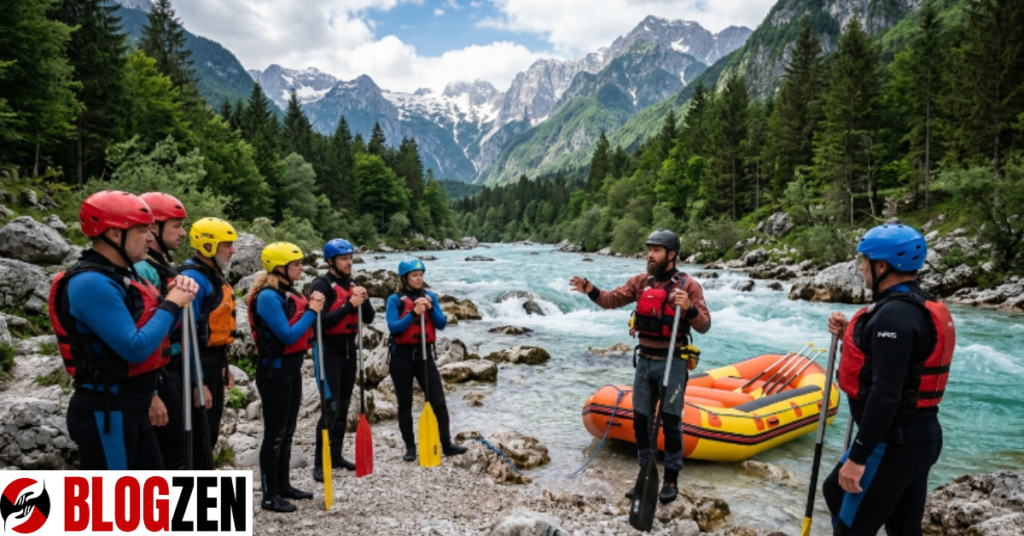
Most first-timers expect to show up, sit in a raft, and drift. That’s not what happens on the Soča — and that’s exactly why people love it.
The standard half-day tour out of Bovec covers the most challenging section of the river, where the Soča runs through a scenic gorge filled with boulders, natural slalom corridors, and sections the guides call “the boulder garden.” You’ll paddle through Class II–III rapids as a team. Each raft holds up to eight people plus a certified guide positioned at the rear, steering with a paddle and giving real-time commands. This isn’t passive. You will paddle, dodge, and get completely soaked — and nobody has ever complained about that part.
Here’s the actual flow of a standard session:
- Check-in at the operator base (usually in Bovec) — gear is distributed, including wetsuit, helmet, lifejacket, and neoprene shoes.
- Drive to the put-in point — about 10 minutes from base. The route is along the river road and the scenery starts here.
- Safety briefing on the bank — guides cover paddle commands, what to do if you fall in, and how to work as a crew.
- On-river time: approximately 1.5 hours — this covers the main rapids section, including potential stops at natural swimming pools and the famous “Manhattan Rock,” a 7-metre boulder you can optionally jump from.
- Take-out point — you exit the river, return gear, and photos taken during the run are often shared free of charge by email.
Total time from arrival to finish: roughly 2.5–3 hours.
The water temperature is cold. Even in July, the Soča runs at around 10–14°C because it originates in alpine snowmelt and underground springs. The wetsuit is not optional — it’s what stands between you and a miserable afternoon. Good operators provide quality neoprene that makes the cold entirely manageable.
The Best Rivers for Rafting in Slovenia — Compared
Not all Slovenian rivers are the same, and choosing the wrong one for your skill level or group can mean either boredom or being out of your depth.
| River | Location | Difficulty | Best For | Price Range |
|---|---|---|---|---|
| Soča (Bovec section) | Bovec, Julian Alps | Class III–IV | Thrill-seekers, intermediate paddlers | €55–€75 |
| Soča (Kobarid section) | Kobarid | Class II–III | Beginners, mixed groups | €45–€65 |
| Sava (Bled section) | Radovljica/Bled | Class I–II | Families, first-timers, kids from age 4 | €35–€50 |
| Sava Bohinjka | Lake Bohinj | Class II | Scenic routes, laid-back adventure | €40–€55 |
The Bovec section of the Soča is the benchmark. It’s where the river narrows through gorge walls and the rapids come in quick succession. The Kobarid section, just downstream, widens and offers a balance between scenery and excitement — the riverbed there features smooth white stones that make the already vivid green water look surreal. The Sava near Bled runs through open valleys with expansive views of the Julian Alps and Karavanke mountain ranges, with Class I–II rapids making it ideal for families with young children.
Pro Tip: The Kobarid section sits just 10 miles from the Italian border. If you’re day-tripping from Trieste or Venice, this is the most accessible option — and it’s every bit as spectacular.
Common Mistakes People Make When Rafting in Slovenia
Most people show up underprepared in specific, predictable ways. Don’t be one of them.
Booking too late. July and August are peak season on the Soča, and the best operators — those with certified IRF guides and consistently high reviews — fill up weeks in advance. Showing up in Bovec hoping to book on the day works sometimes in June or September. In midsummer, you’ll be left choosing whoever has space, not whoever is best.
Wearing the wrong clothes underneath. The operator provides a wetsuit, but you wear something under it. Cotton is the enemy — it holds water and chills you fast. Wear a thin synthetic base layer or swimwear. Leave the jeans and regular socks in the car.
Underestimating the river permit cost. Here’s something most booking sites bury: since March 2024, a river permit fee of €18–21 per person is required for the Kobarid section of the Soča, plus an additional €10/day environmental tax. Some operators include this in their price; others don’t. Always confirm what’s included before paying.
Skipping the safety briefing mentally. Every guide gives a pre-raft briefing. A surprising number of guests treat it as background noise. The commands — “paddle forward,” “stop,” “get down” — are the difference between an exciting run and an unplanned swim. Listen. It takes five minutes and it matters.
Choosing a tour based purely on price. The cheapest option is rarely the smartest. Quality operators maintain their gear daily and employ guides certified by the IRF (International Rafting Federation) or the Slovenian Rafting Association, plus mandatory whitewater rescue certification. A €10 saving is not worth a poorly maintained raft or an inexperienced guide on Class III water.
Expert Tips for Getting the Most Out of Your Rafting Trip
The difference between a good day on the river and a genuinely unforgettable one usually comes down to a few small decisions made before you ever get wet.
Go in May or early June if you want the best conditions. This is when snowmelt from the Julian Alps feeds the Soča at its most powerful, creating higher, faster water and more energetic rapids. The crowds are also thinner than peak July and August. Late September offers a quieter experience with autumn colours starting to appear on the valley walls — arguably the most beautiful time visually.
Ask your operator about small-group tours. Some Bovec operators cap their rafts at six people instead of eight. Smaller groups move through technical sections faster, you spend less time waiting, and the guide can actually connect with you during calm stretches.
If you’re travelling with children, the Sava near Bled accepts kids from age 4. The Soča operators typically require a minimum age of 7–8 years for the calmer Kobarid section and 14+ for the Bovec rapids. Check age requirements before booking to avoid a disappointed child at the check-in desk.
Here’s an observation from following this destination for a while: the operators founded by competitive rafters — some Bovec agencies are run by former world rafting champions — consistently deliver a higher technical experience. They paddle better lines, they read the river in real time, and they know which rapids are worth stopping at for a photo and which ones deserve full speed.
The Boka Waterfall is visible from the river. On the Bovec section, you pass the approach to the Boka Waterfall, one of the highest in Slovenia. Most guides point it out. If yours doesn’t mention it, ask — you don’t want to be looking the wrong way.
Pro Tip: Book a morning slot (typically 10am) rather than afternoon (2:30pm). The light on the Soča in the morning is extraordinary — the emerald colour is most vivid before midday, and you’ll want every photo you take.
Real Experiences: What Visitors Actually Say
Numbers matter here. On GetYourGuide, Bovec rafting experiences consistently earn ratings above 4.9 out of 5, with several operators holding averages based on hundreds of verified reviews. On TripAdvisor, guides are mentioned by name — “Juan,” “Peter,” “Camilla” — in the kind of language people use when an experience has genuinely moved them.
One traveller from Saudi Arabia put it simply: “This is really a must-do activity. The instructor was so kind and the activity itself was really super.” A visitor from Finland noted: “This was one of the most fun things we did in Slovenia. We got a private tour and had plenty of time to jump off a cliff.” These aren’t outliers. The consistency of the praise across platforms points to something genuine about the quality of guiding in this part of Slovenia.
What keeps coming up across hundreds of reviews is the same thing: the combination of cold, clean emerald water, skilled and genuinely enthusiastic guides, and a landscape so beautiful it feels cinematic. One Belgian traveller described it as “a perfect mix of excitement, refreshment, and sportivity.” That’s a made-up word, but it captures something real.
Myths vs. Facts: What People Get Wrong About Rafting in Slovenia
Myth: You need prior experience. Fact: You don’t need any. Every reputable operator designs their tours for first-timers. The guide controls the boat; your job is to paddle when told and hold on when needed. Tens of thousands of complete beginners run the Soča every year without incident.
Myth: It’s only good for thrill-seekers. Fact: The Soča has sections suitable for children from age 7, and the Sava near Bled is specifically designed for families with kids as young as 4. The adventure spectrum here is genuinely wide.
Myth: The water is warm in summer. Fact: The Soča stays cold — around 10–14°C — even at peak summer because it’s alpine-fed. The wetsuit provided by your operator handles this, but walk in expecting a warm swim and you’ll be surprised.
Myth: Any time of year works. Fact: The season runs April to October. Outside this window, most operators shut down. The river in winter is too cold and unpredictable for recreational rafting.
Myth: All sections are equally challenging. Fact: The Soča alone varies from Class II near Kobarid to Class IV in its upper Bovec section. Picking the right section for your group’s ability makes the difference between an exhilarating challenge and something genuinely dangerous.
Pro Tip: If the Soča is running milky turquoise or grey after heavy storms or spring snowmelt, that’s not a reason to cancel — it means the river is carrying alpine sediment and running at its wildest. Some operators will adjust the route; the experience of seeing the river in that state is itself unique.
Conclusion
Three things are worth holding onto after everything above. First, the Soča River is the centrepiece — nothing else in central Europe quite compares for the combination of technical rapids and landscape beauty. Second, preparation separates a good trip from a great one: book early, dress right, and choose certified operators who know this river the way a sommelier knows a vineyard. Third, Slovenia’s rafting scene caters to everyone — from the nervous first-timer on the Sava to the experienced paddler chasing Class IV lines near Bovec.
The water will be cold. You will be wet. You will be grinning from the moment the first real rapid hits until long after you’ve towelled off.
Have you been rafting on the Soča, or are you planning your first trip? Drop a question or experience in the comments — and if you’re still deciding which section to tackle, check out our guides to the best things to do in Bovec and Lake Bled for the full picture.
The Soča doesn’t wait. Neither should you.
FAQs
Is whitewater rafting in Slovenia suitable for beginners?
Absolutely. The majority of rafting tours on the Soča and Sava rivers are specifically designed for people with zero prior paddling experience. Certified guides handle navigation and give clear paddle commands throughout the trip. The Sava River near Bled offers the gentlest introduction — Class I–II water suitable for ages 4 and up. Even on the more exciting Soča, beginners run Class II–III rapids safely every day during peak season, supported by mandatory safety briefings and IRF-certified guides.
What is the best time of year to go whitewater rafting in Slovenia?
The season runs from April through October. For the most powerful rapids, go in May or early June when alpine snowmelt swells the Soča to its fullest. July and August offer warm air temperatures and peak atmosphere, but expect crowds and book well in advance. September is an excellent sweet spot — fewer tourists, autumn colours emerging on the valley walls, and the river still running strong. Avoid spring weekends in July–August without prior booking; the best operators fill up fast.
How much does rafting on the Soča River cost?
Prices vary by operator and section. Classic half-day whitewater rafting in Slovenia on the Soča near Bovec typically starts from €55–€75 per person. The Sava River near Bled is more affordable at €35–€50. Be aware that since March 2024, the Kobarid section of the Soča requires a river permit of €18–21 per person plus a €10/day environmental access fee. Some operators include this; others charge it separately. Always confirm what’s included before booking.
What should I wear and bring for a rafting trip?
Your operator will provide: wetsuit, helmet, lifejacket, and neoprene shoes. What you should wear underneath:
- Synthetic base layer or swimwear (avoid cotton — it holds water and chills fast)
- Secure footwear if you prefer your own (trail runners work if you don’t mind them getting soaked)
- Sunscreen applied before you put on the wetsuit Bring a change of dry clothes and a towel for afterwards. Leave your phone in the car or ask your operator about waterproof storage — most provide dry bags or lockers at the base.
Can children go whitewater rafting in Slovenia?
Yes — with the right section. The Sava River near Lake Bled is family-friendly from age 4, offering Class I–II rapids in open scenic valleys. On the Soča, the Kobarid section accepts children from around age 7–8, while the more challenging Bovec section is typically restricted to ages 14 and above. Always verify the minimum age with your specific operator when booking, as policies vary slightly. Family-specific tours exist across Slovenia with smaller rafts and pacing adjusted for younger paddlers.
What makes the Soča River’s colour so uniquely green?
The Soča’s vivid emerald colour comes from a combination of factors that don’t occur in most rivers. The water originates from an underground lake and alpine springs, which keeps it exceptionally cold and clear with very low sediment under normal conditions. The riverbed is composed of white limestone and dolomite rock, which reflects light upward through the water column. The resulting mineral composition refracts light in a way that produces that intense, almost unreal turquoise-green hue. After heavy rainfall or rapid snowmelt, the colour shifts to a milky turquoise or grey as sediment enters — a reminder that this is a genuinely wild alpine waterway.
