


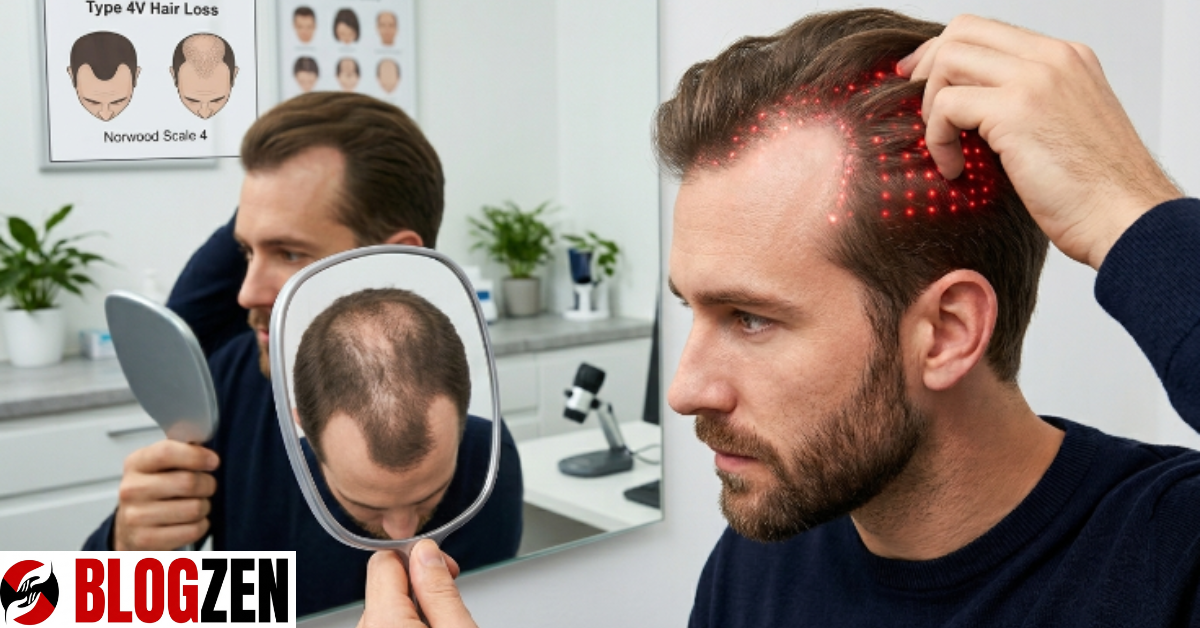
Quick Answer
A mature hairline naturally moves back 1–1.5 cm from your teenage position and stabilizes — it’s normal. A receding hairline keeps moving, thins unevenly, and signals pattern hair loss. The key difference is progression: one stops, the other doesn’t.
Half the men who think they’re going bald… aren’t. That’s not wishful thinking — it’s a well-documented confusion between two completely different things: a mature hairline and a receding one. Getting this wrong can cost you money, stress, and unnecessary treatment.
If you’ve been staring into the mirror lately wondering whether your mature vs receding hairline situation is serious, you’re asking exactly the right question. Most dermatologists will tell you the two are routinely misdiagnosed — even by patients who’ve been watching their hair for years.
In this article, you’ll learn how to tell the difference with real precision, what the science says about each, the biggest mistakes men make when assessing their own hair, and what to actually do about it — depending on which category you fall into. No guesswork. No fluff.
What Is a Mature Hairline — and Why Most Men Get It
Almost every man experiences a hairline change between the ages of 17 and 29. During puberty and early adulthood, your hairline shifts upward slightly from the low, rounded “juvenile” position you had as a child. This is called a mature hairline — and it is completely, biologically normal.
A mature hairline typically recedes by about 1 to 1.5 centimeters from the juvenile position, often forming a slight M-shape or a more defined widow’s peak. The temples pull back a touch, the overall density stays roughly the same, and — crucially — it stops moving after that. No thinning. No acceleration. Just a natural adult repositioning.
Studies estimate that around 95% of men will develop a mature hairline. So if your hairline has shifted slightly and then held steady for a year or two, you are almost certainly in this completely normal category — not losing your hair, just finishing the transition to adulthood.
Pro Tip: Take a photo of your hairline every 3 months under the same lighting. The single most reliable way to tell if your hairline is maturing (stable) or receding (progressive) is direct photo comparison over time — not mirror anxiety.
What Is a Receding Hairline — and How It Actually Works
A receding hairline is a sign of androgenetic alopecia — commonly called male pattern baldness — and it behaves very differently from a simple maturation process. It doesn’t stop. It progresses. And the earlier it starts, the more important it is to catch it correctly.
The driving force behind a receding hairline is DHT (dihydrotestosterone), a derivative of testosterone. In genetically susceptible follicles, DHT causes the hair follicle to miniaturize over time — meaning each new hair grows thinner and shorter until eventually the follicle stops producing visible hair altogether. This is why a receding hairline is often accompanied by thinning at the crown or an overall reduction in hair density, not just hairline movement.
The Norwood Scale, the industry-standard classification system, identifies 7 stages of male pattern baldness — from a minimal hairline change at Stage 1, all the way to near-complete hair loss at Stage 7. A mature hairline corresponds roughly to Stage 1–2, while true hair loss progression moves into Stage 3 and beyond. The difference is clinical, measurable, and very much real.
Pro Tip: Run a fingers-through test. Take a small section of hair at the temple and gently pull. If you’re consistently pulling out 3–5 hairs with minimal force over several weeks, that’s a sign of active shedding associated with a receding hairline — not normal daily loss of 50–100 strands.
Mature vs Receding Hairline: The Exact Signs to Look For
Here’s what nobody tells you: the biggest visible difference between a mature and receding hairline isn’t how far back it sits — it’s the quality of the hair and whether the line keeps moving.
| Feature | Mature Hairline | Receding Hairline |
|---|---|---|
| Movement | Stops after slight shift (1–1.5 cm) | Continues progressing over months/years |
| Hair density | Density stays consistent | Hair becomes finer, shorter, thinner |
| Temple shape | Slight symmetrical recession | Asymmetric or deep temple recession |
| Crown involvement | Not affected | Often involves thinning at crown too |
| Age of onset | Typically 17–29 | Can start at any age from teens onward |
| Scalp visibility | Minimal or none | Increasing scalp show-through over time |
| Family history relevance | Not strongly linked | Strongly hereditary (both maternal & paternal) |
Think of it this way: a mature hairline is a destination. A receding hairline is a direction. If you’re still moving after 24 months, that’s a signal worth taking seriously.
Common Mistakes Men Make When Assessing Their Own Hairline
Most people get this completely wrong — and the errors tend to run in two directions: panicking too early, or denying too long. Both carry real costs.
Mistake 1: Comparing your hairline to your teenage self
Your juvenile hairline was never meant to last. Comparing your adult hairline to a photo from age 14 will almost always look like “recession” — because you’ve grown up. The relevant comparison is between your current hairline and your hairline 12–18 months ago.
Mistake 2: Judging by hairline position alone
Men fixate on how far back the hairline sits. But position tells only half the story. Hair caliber — the thickness and diameter of individual strands — is actually a more reliable early indicator of androgenetic alopecia than position alone. If your temples look slightly sparse but individual hairs remain thick, that looks very different from temples where the hairs are becoming wispy and translucent.
Mistake 3: Self-diagnosing under harsh or unflattering lighting
Overhead fluorescent lighting can make almost any hairline look thinner than it is. If your “assessment” only happens under a bright bathroom light or in a car mirror, you’re working with bad data. Natural, diffused light gives a far more accurate read on actual density and line position.
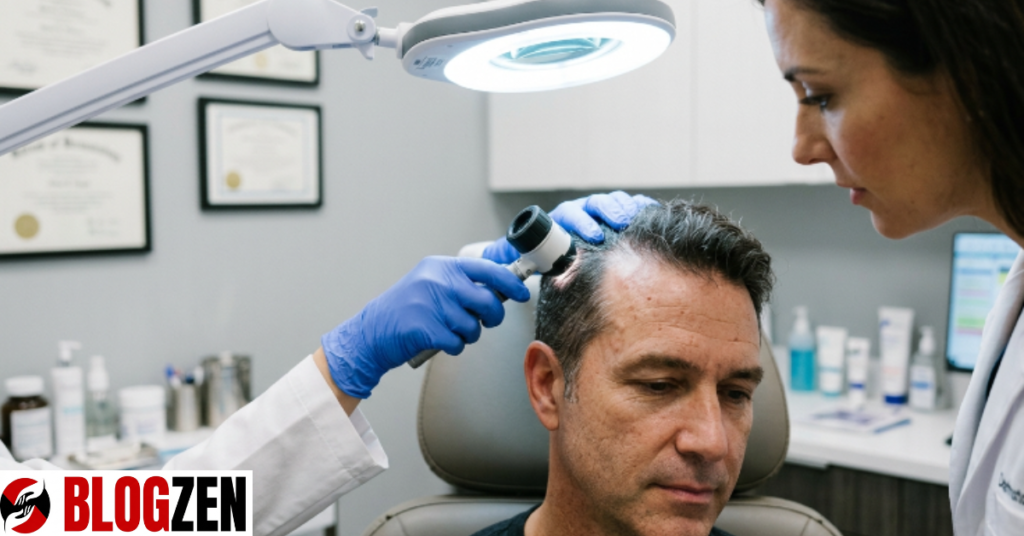
Pro Tip: If you’re unsure, a trichologist or dermatologist can perform a trichoscopy — a non-invasive scalp exam using a dermatoscope — that measures hair follicle diameter and miniaturization percentage with actual accuracy. It takes under 10 minutes and removes all guesswork.
Expert Tips: What to Do Based on Which Type You Have
The right response to a mature hairline is essentially: nothing. Monitor it, track it with photos, and move on. There’s no treatment needed and no cause for alarm.
A receding hairline is a different story — but the good news is that there are genuinely effective, evidence-backed options available, particularly when caught early. Here’s what actually works:
- Minoxidil (topical or oral): The most widely used over-the-counter treatment. Topical 5% minoxidil is clinically proven to slow hair loss and, in many cases, stimulate regrowth. Oral low-dose minoxidil (0.25–1.25 mg daily) has shown strong results in recent studies and is increasingly prescribed off-label.
- Finasteride (1mg daily): A prescription DHT-blocker that addresses the root hormonal cause of androgenetic alopecia. Studies show it halts progression in roughly 83% of men and produces visible regrowth in about 66%. Most effective when started early.
- Combination therapy: Research consistently shows that minoxidil + finasteride together outperform either treatment alone — this is now considered the gold standard protocol by many hair loss specialists.
- Hair transplant (FUE or FUT): A surgical option best reserved for men whose hair loss has stabilized. Transplanting into an actively receding zone without medical stabilization first often produces poor long-term results.
- Low-Level Laser Therapy (LLLT): FDA-cleared devices (combs, caps, helmets) that use red light to stimulate follicle activity. Evidence is moderate but improving; best used as an adjunct rather than a standalone treatment.
Real-World Examples: What This Actually Looks Like
Let me give you two real scenarios that illustrate how this plays out in practice.
Scenario A: The false alarm
A 22-year-old notices his temples have pulled back compared to photos from high school. He’s convinced he’s losing his hair. A dermatologist confirms the hairline has shifted roughly 1.2 cm symmetrically — the hair at the temples is still full-caliber, dense, and consistent. No miniaturization detected on trichoscopy. Diagnosis: mature hairline, no treatment required. Follow-up in 12 months with photos confirmed zero further movement.
Scenario B: The real deal
A 28-year-old notices his temples have “always been like this” — but over the last year, the line has crept back another centimeter. He also notices more scalp visible at his crown when photographed from above. His father was significantly bald by 35. Trichoscopy reveals 30% miniaturization of follicles at the hairline temples — a clear early sign of androgenetic alopecia. He starts finasteride and topical minoxidil. One year later, progression has halted entirely.
Pro Tip: Family history matters — but it’s not destiny. Genetics loads the gun; DHT pulls the trigger. Men with strong family history of hair loss who start DHT-blocking treatment in their early 20s (when the first changes appear) have dramatically better long-term outcomes than those who wait until significant loss has occurred.
Myths vs Facts: What You’ve Probably Been Told That Isn’t True
Hair loss myths are everywhere — and some of them actively delay men from getting the right help at the right time. Let’s clear them up.
Myth: “If it’s inherited from your mother’s side, you’ll go bald.”
Fact: Hair loss genetics are polygenic, meaning they’re inherited from both parents. The maternal grandfather theory is an oversimplification. Look at both sides of your family tree.
Myth: “Wearing hats causes hair loss.”
Fact: No credible study has linked hat-wearing to androgenetic alopecia. Hats don’t block blood flow or damage follicles in any meaningful way under normal use.
Myth: “If you’re losing hair at 19, it’ll all be gone by 25.”
Fact: The rate of progression is highly individual and can be dramatically slowed with early intervention. Early onset doesn’t automatically mean rapid total loss.
Myth: “Natural remedies like rosemary oil work as well as finasteride.”
Fact: One small study compared rosemary oil to 2% minoxidil (not the standard 5%) and found roughly equivalent results for that specific formulation. The evidence base for natural remedies remains thin compared to FDA-approved treatments. Rosemary oil may help mildly — it won’t stop DHT-driven miniaturization.
Final Word: Stop Guessing, Start Knowing
Here’s the bottom line. The difference between a mature vs receding hairline comes down to three things: progression, density, and follicle health. A mature hairline moves slightly and stops — it’s biology finishing its job. A receding hairline keeps moving, brings thinning with it, and responds to DHT in a way that requires attention.
The single best thing you can do right now is take a clear photo today, and another in three months, under the same conditions. That data tells you more than any mirror session ever will.
If you’re seeing real signs of progression, don’t wait. Treatment works best early — the follicles that are still alive and just miniaturizing can be rescued far more easily than follicles that have been dormant for years.
Have you recently noticed changes in your hairline? Drop a comment below and describe what you’re seeing — the community (and this author) will weigh in. And if you’re ready to take the next step, check out our guide to the best clinically proven hair loss treatments available in 2025.
Your hairline has a story — make sure you’re reading it correctly.
FAQs
How do I know if I have a mature vs receding hairline?
The clearest way to distinguish a mature vs receding hairline is time. Take photos every 3 months and compare. A mature hairline shifts slightly — typically 1 to 1.5 cm from the juvenile position — and then holds firm. A receding hairline continues to move back, and the hair at the temples often becomes finer and shorter. Scalp visibility increasing over 6–12 months is a reliable warning sign that warrants a dermatologist visit.
At what age does a mature hairline develop?
Most men develop a mature hairline between ages 17 and 29, with the peak shift usually happening in the late teens to early twenties. It typically completes within a few years. If your hairline is still visibly moving after age 30, especially with accompanying thinning or density loss, it is less likely to be simple maturation and more likely early-stage androgenetic alopecia requiring evaluation.
Can a receding hairline stop on its own without treatment?
Occasionally yes — some men experience a very slow or arrested progression naturally. However, untreated androgenetic alopecia typically follows a progressive course driven by ongoing DHT exposure. Without intervention, most men see continued loss over years and decades. Spontaneous stabilization without treatment is the exception, not the rule. Relying on it as a strategy is a gamble that rarely pays off in the long term.
Does a mature hairline mean you won’t go bald?
Not necessarily — but it is a positive sign. Developing a mature hairline is a normal biological process that affects nearly all men. Critically, many men who develop a mature hairline in their 20s never progress further. However, if you carry the genetic variants for androgenetic alopecia, the same DHT sensitivity that drives pattern baldness can still activate later. A stable mature hairline is reassuring, but monitoring annually is still worthwhile.
What does a receding hairline look like in early stages?
In the early stages — roughly Norwood Stage 2–3 — a receding hairline shows as:
- A deepening or sharpening of the temple recession beyond a symmetrical V or M
- Individual hairs at the hairline becoming finer (miniaturization) rather than abruptly absent
- Slight scalp show-through under bright lighting at the temples or front hairline
- A widening center part that wasn’t there before
Most men notice one of these before the others — the widening part is often the first thing spotted in overhead lighting.
Is DHT the only cause of a receding hairline?
DHT (dihydrotestosterone) is the primary hormonal driver of androgenetic alopecia — the most common cause of a receding hairline in men. But other factors can contribute or accelerate the process: chronic telogen effluvium (stress-induced shedding), nutritional deficiencies (particularly iron and ferritin in women), thyroid dysfunction, and certain medications (including anabolic steroids, which spike DHT dramatically). A receding hairline without a family history warrants bloodwork to rule out these secondary causes.
