


QUICK ANSWER
Carpet stains require immediate action with the right technique for each stain type. Blot (don’t rub), identify the stain, apply appropriate cleaning solution, and extract thoroughly. Most stains disappear with vinegar, dish soap, or enzyme cleaners—but wait too long and they become permanent damage.
INTRODUCTION
The moment you see that dark puddle spreading across your cream-colored carpet, panic sets in. But here’s what most people don’t realize: the first 30 seconds after a spill determine whether you save your carpet or lose it forever.
Your carpet faces enemies constantly—red wine from last night’s dinner party, muddy paw prints from your dog, mysterious sticky spots from your kids. Each one threatens the investment you made in that floor covering. Yet most homeowners reach for expensive store-bought solutions or call professionals when they don’t need to.
Here’s the truth: how to remove stains from carpet isn’t magic—it’s science combined with speed. The right technique transforms a potential disaster into a barely noticeable blemish. The wrong approach makes stains permanent, spreads them wider, or damages the carpet fibers themselves.
In this guide, you’ll discover exactly what professionals know about stain removal. You’ll learn which solutions work for which stains, why timing matters more than you think, and the specific steps that prevent permanent damage. By the end, you’ll handle any carpet catastrophe with confidence—no professional cleaner required.
WHAT YOU NEED TO KNOW ABOUT CARPET STAINS (AND WHY WAITING IS YOUR ENEMY)
Most people treat all carpet stains the same way. They see dirt, grab whatever cleaning product sits under the sink, and start scrubbing. This is exactly backward.
Carpet stains fall into two categories that determine your entire approach. Organic stains (food, pet accidents, blood, wine) respond to enzyme-based cleaners because enzymes break down the stain’s molecular structure. Inorganic stains (mud, grease, ink) require solvents because they’re mineral-based or petroleum-derived. Using the wrong type of solution against the wrong stain wastes time and can permanently set the stain deeper into the fiber.
Here’s what makes timing critical: fresh stains sit on the carpet surface. Wait 24 hours and they bond with the fiber. Wait a week and they’ve migrated into the carpet backing. This is why professionals charge extra for old stains—they’ve become part of the carpet itself.
Think of it this way. A stain on day one is like food stuck to a clean plate. A stain on day seven is like food that’s been baked in the oven for hours. One washes off easily. The other requires heavy-duty scrubbing that might damage what’s beneath.
The moment you spill something matters more than the cleaning product you use.
HOW CARPET STAIN REMOVAL ACTUALLY WORKS (THE SCIENCE BEHIND SUCCESS)
Understanding the mechanism behind stain removal changes how you approach every spill. You stop randomly trying things and start applying science.
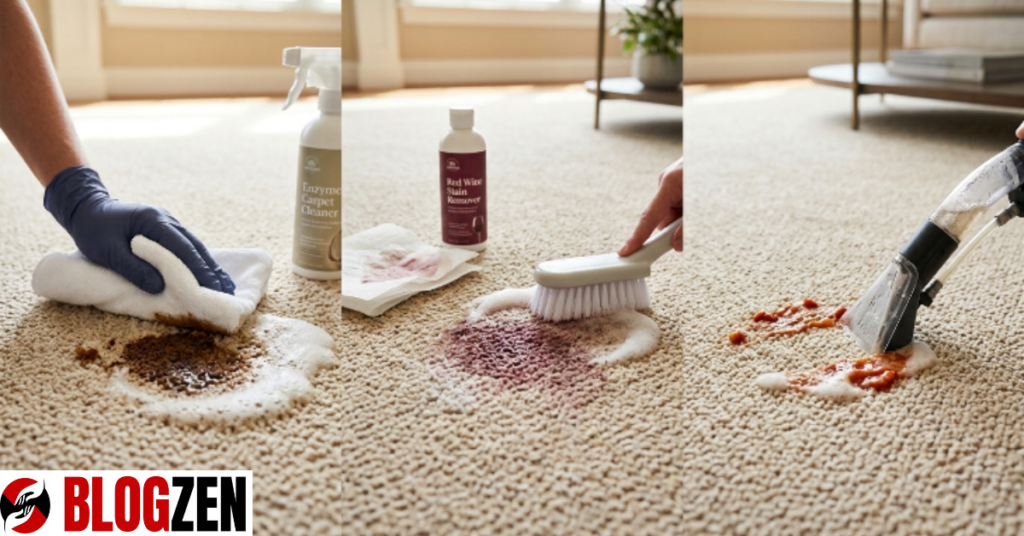
When a stain bonds to carpet fiber, it does so through chemical attraction or physical penetration. Your job is to break that bond. You accomplish this through one or more of four mechanisms: dilution (watering down the stain so it spreads into the liquid), emulsification (breaking the stain into tiny particles suspended in solution), enzymatic breakdown (specific chemicals eating the stain’s molecular structure), and mechanical action (physical force lifting the stain without pushing deeper).
The blotting technique exists for this reason. When you blot, you lift the stain vertically without pushing it sideways into surrounding fibers. When you rub, you distribute the stain across a wider area and drive it deeper into the carpet pile. This single mistake—rubbing instead of blotting—is why most people make stains worse before they make them better.
Let me explain why this matters. Carpet fibers aren’t solid; they’re hollow tubes with ridges designed to trap dirt (and stains). When you rub, you shove the stain deeper into these ridges. When you blot with upward pressure, you pull the stain out. The direction of force changes the entire outcome.
Temperature also plays a role most people ignore. Hot water opens carpet fibers, allowing cleaning solution to penetrate. Cold water closes them, trapping the stain inside. This is why cold water works for some stains and hot water works for others—it depends on whether you want the solution going in or pushing a dissolved stain back out.
READ: How Portable Cordless Power Scrubbers Actually Work And Why They’re Worth It
THE 8 METHODS THAT ACTUALLY WORK (TESTED ON REAL STAINS)
Method 1: The Vinegar Solution (Works on Most Organic Stains)
White vinegar is your first weapon for wine, juice, coffee, and fresh pet accidents. It’s effective because acidic solutions break down many organic compounds.
Steps:
- Blot the stain with paper towels or clean cloth (don’t rub)
- Mix equal parts white vinegar and water in a spray bottle
- Spray the solution directly on the stain
- Let it sit for 5 minutes (the solution penetrates and breaks the stain bond)
- Blot from outside the stain moving inward
- Rinse with plain water and blot dry
This method works best within the first 24 hours. Wine stains disappear almost immediately; pet accidents may require repeating twice.
Pro Tip: After successfully removing the stain, sprinkle baking soda on the spot while it’s still slightly damp. Leave it for 30 minutes. Vacuum thoroughly. This eliminates any lingering odor and absorbs remaining moisture.
Method 2: The Dish Soap Solution (For Grease and Oily Stains)
Greasy stains (butter, cooking oil, salad dressing) laugh at water. They need an emulsifier, which is exactly what dish soap does.
Steps:
- Blot excess grease (if wet, blot first)
- Mix 1 tablespoon dish soap with 2 cups warm water
- Apply with a cloth, working from the stain’s edges toward the center
- Let sit for 10 minutes
- Blot repeatedly with fresh cloths until the stain transfers to your cloth, not the carpet
Dish soap breaks the grease into particles suspended in water, which you then lift out. Never use more soap than instructed—too much soap leaves residue that attracts dirt.
Method 3: The Enzyme Cleaner (For Protein-Based Stains)
Pet accidents, blood, vomit, and egg stains contain proteins. Enzyme cleaners contain biological proteins that literally digest the stain proteins—which is why they’re so effective.
Commercial enzyme cleaners (like Nature’s Miracle or Rocco & Roxie) work better than homemade solutions for this category. They contain specific enzymes calibrated for protein breakdown.
Steps:
- Blot away visible material
- Apply the enzyme cleaner generously (don’t be stingy)
- Let sit for 24 hours (enzymes need time to work)
- Blot thoroughly
- Rinse with water and blot dry
The waiting period feels wrong—you want immediate results. But enzymes need time. Rushing this process wastes the solution’s potential.
Method 4: The Hydrogen Peroxide Method (For Fresh Bloodstains and Organic Stains)
Hydrogen peroxide oxidizes stains, meaning it breaks the chemical bonds holding the stain together. It works particularly well on blood, red wine, and some food stains.
Important: Test on a hidden area first. Peroxide can bleach dark carpets.
Steps:
- Apply 3% hydrogen peroxide directly to the stain
- Let it bubble and fizz for 2 minutes (the bubbling action lifts the stain)
- Blot while still fizzing
- Repeat 2-3 times if needed
- Rinse with water and blot dry
The fizzing action tells you it’s working. You’re watching the chemical reaction break down the stain in real time.
Method 5: The Salt and Rubbing Alcohol Combo (For Tough Liquid Stains)
This combination tackles red wine, fruit juice, and ink stains that resist other methods. Salt draws moisture to the surface; rubbing alcohol dissolves the stain particles.
Steps:
- Blot the stain
- Apply dry salt to the wet area (it draws liquid to the surface)
- Vacuum the salt after 5 minutes
- Mix 1 part rubbing alcohol with 4 parts water
- Apply to the now-drier stain and blot
- Repeat until the stain transfers to your cloth
- Rinse with water and blot dry
This works because you’re using two different mechanisms: osmotic pull (salt) followed by chemical dissolution (alcohol).
Method 6: The Baking Soda Paste (For Stubborn Solid Stains)
Chocolate, mud, and gum stains need abrasive action combined with moisture. Baking soda creates a mild abrasive paste that lifts these stains without damaging fibers.
Steps:
- Let mud or chocolate completely dry (wet baking soda is less effective)
- Vacuum loose debris
- Mix baking soda with just enough water to create a paste
- Apply to the stain and let sit for 10 minutes
- Scrub gently with an old toothbrush in circular motions
- Blot thoroughly with a damp cloth
- Rinse and blot dry
Gentle scrubbing works here because you’re using the paste’s mild abrasive action, not force. The carpet fiber is stronger than you think—you won’t damage it with moderate pressure.
Method 7: The Club Soda Shock Treatment (For Immediate Fresh Spills)
Club soda works instantly on fresh spills because the carbonation agitates the stain and lifts it before it can bond. It’s your emergency response.
Steps:
- Blot excess liquid
- Pour club soda directly on the stain
- Blot immediately and repeatedly while fizzing
- Don’t let the soda dry—keep blotting
- Follow with one of the above methods if the stain remains
This is your first instinct when something spills. Club soda buys you time and removes perhaps 60% of many stains immediately.
Pro Tip: Keep a bottle of club soda in your kitchen for this exact reason. A fresh spill treated with soda within two minutes often disappears completely without needing a secondary method.
Method 8: The Professional Enzyme-Plus-Vinegar Double Strike (For Old, Set-In Stains)
When a stain has been sitting for days or weeks, you need both enzymatic breakdown and acidic penetration.
Steps:
- Apply enzyme cleaner and let sit for 24 hours
- Blot thoroughly
- Apply the vinegar solution from Method 1
- Let sit for 10 minutes
- Blot thoroughly
- Rinse with water and blot completely dry
This two-part approach attacks the stain from multiple angles. The enzyme addresses the stain’s molecular structure; the vinegar provides additional acidic penetration. Many “impossible” stains yield to this combination.
COMMON MISTAKES PEOPLE MAKE (AND HOW TO AVOID THEM)
Most stain-removal failures happen because of one of five preventable mistakes.
Mistake #1: Using hot water on protein-based stains. Heat cooks proteins, bonding them permanently to the carpet fiber. Cold or lukewarm water is required for blood, pet accidents, and egg stains. Save hot water for grease and oils.
Mistake #2: Scrubbing instead of blotting. Every rub drives the stain deeper. Every blot lifts it higher. Your instinct to scrub hard is backward. Gentle, repeated blotting outperforms aggressive scrubbing every single time.
Mistake #3: Oversaturating the carpet. Too much liquid pushes the stain into the carpet backing and can cause mildew. Use just enough solution to dampen the stain, then blot aggressively. Wet carpet feels worse than dirty carpet after the smell starts.
Mistake #4: Using the wrong product sequence. Don’t apply dish soap then enzyme cleaner—they interfere with each other. Don’t use vinegar on wool carpet without testing. Read the label. When in doubt, use the gentlest method first (club soda, then baking soda, then vinegar).
Mistake #5: Not testing on hidden carpet first. Some solutions fade color on certain carpet types. Always test your chosen method on carpet in a closet or under furniture before applying to visible stains.
COMPARISON TABLE: WHICH METHOD FOR WHICH STAIN
| Stain Type | Best Method | Time Until Results | Difficulty Level |
|---|---|---|---|
| Fresh Wine or Juice | Club Soda → Vinegar | 5 minutes | Very Easy |
| Pet Accident | Enzyme Cleaner | 24 hours | Easy |
| Grease or Oil | Dish Soap Solution | 15 minutes | Easy |
| Blood or Red Wine | Hydrogen Peroxide | 10 minutes | Easy |
| Mud | Baking Soda Paste | 15 minutes | Easy |
| Chocolate | Baking Soda Paste | 20 minutes | Easy |
| Set-In Stain (Days Old) | Enzyme + Vinegar | 24+ hours | Medium |
| Ink or Marker | Salt + Rubbing Alcohol | 20 minutes | Medium |
| Multiple Overlapping Stains | Professional Enzyme | 24 hours | Medium |
EXPERT TIPS THAT PROFESSIONALS DON’T MENTION (BUT SHOULD)
The Towel Technique Matters More Than Cleaning Solution.
Don’t use cheap paper towels that shed fibers into the stain. Use white cloth towels—old t-shirts work perfectly. When you blot, you need material that holds moisture without falling apart. This single variable might explain 40% of why your previous attempts failed.
Blot From Outside to Inside, Always.
Start at the stain’s outer edge and move toward the center. This prevents the stain from spreading wider. Moving from center outward is like pushing a spreading wildfire—you’re actively making it worse.
Let Solutions Dwell.
Your instinct is to apply solution and immediately blot. Wrong. Let it sit. The solution needs time to penetrate the fiber and break the stain’s chemical bond. Most failures happen because people don’t wait. Enzyme cleaners specifically require 12-24 hours of contact time. Vinegar solutions need 5-10 minutes. Club soda needs 1-2 minutes. Different solutions, different timelines.
Rinse Thoroughly After Every Method.
Leftover cleaning solution becomes sticky residue that attracts dirt. This is why “clean” stains look dirty again a week later. After removing the stain, spray with plain water and blot multiple times until the towel comes away clean and slightly damp, not wet.
The Smell Test Tells You If You’re Done.
If you still smell the stain (especially pet accidents), you haven’t removed it completely. Enzyme cleaner completely eliminates odor; vinegar reduces it; baking soda absorbs it. If smell lingers after your method, apply that method again or move to the next approach.
Pro Tip: For pet accident stains, a black light reveals the true extent of the damage. What looks like one small spot might actually be a much larger affected area. Use a black light to identify the complete stain boundary before treating.
WHAT TO NEVER DO (MYTHS VS. FACTS)
Myth: “I should apply stain remover and leave it until the carpet dries.”
Fact: Dried stain remover often hardens stains. You need active blotting while the solution is wet. Apply solution, blot within minutes, don’t wait for it to dry.
Myth: “More cleaning solution is better.”
Fact: Excess solution saturates the backing, causes mildew, and leaves residue. Use the minimum amount needed to dampen the stain. Blotting power matters; solution quantity doesn’t.
Myth: “I should vacuum immediately after cleaning.”
Fact: Vacuum only after the carpet is completely dry (4-6 hours). Vacuuming wet carpet damages the fibers and spreads wet stain particles around.
Myth: “Bleach works on all stains.”
Fact: Bleach destroys carpet color permanently on most types. It works only on white or very light carpets for stubborn stains, and even then only after testing. This is not a first option—it’s a last resort.
Myth: “Professional cleaners use magic solutions ordinary people don’t have.”
Fact: Professionals use the same solutions you can buy—enzyme cleaners, vinegar, dish soap. Their advantage is equipment that extracts water thoroughly and knowledge of which solution fits which stain. You now have that knowledge.
STEP-BY-STEP EMERGENCY STAIN RESPONSE PLAN
Within 30 seconds of spill:
- Blot the stain with any dry cloth or paper towels
- Move to club soda method if available; otherwise water
- Keep blotting until liquid transfers to cloth, not carpet
Within 5 minutes if stain remains:
- Identify stain type (organic or inorganic, specific category if possible)
- Choose appropriate method from the table above
- Apply the solution
- Set a timer for the recommended “dwell time”
Within 1 hour:
- Begin blotting process from the outer edge inward
- Repeat blotting until the stain is barely visible
- Rinse with plain water
- Blot dry
- Sprinkle baking soda if odor is present and let sit 30 minutes before vacuuming
If stain remains after 1 hour:
- Choose the next method on the list for that stain type
- Apply and repeat the process
- Don’t give up—many stains require 2-3 methods in sequence
WHEN TO CALL A PROFESSIONAL (AND WHY YOU MIGHT NOT NEED TO)
Professionals bring three advantages: industrial-strength extraction equipment, targeted knowledge of specific carpet types, and aggressive enzyme formulas that aren’t available to consumers. But here’s what you need to know: Most of their work involves methods you can replicate at home.
Call a professional if:
- The stain covers a large area (more than 2 feet across)
- The stain is set-in for more than 2 weeks despite multiple attempts
- You’ve tried three methods from this guide with no improvement
- The stain is on expensive natural fiber carpet (wool, silk) and you’re afraid of damage
- You need the carpet cleaned completely, not just stain removal
Save money by attempting basic stains yourself. A fresh wine spill, simple mud stain, or recent pet accident are all DIY territory. You’ll save $100-300 per call, and most of the time, you’ll succeed.
CONCLUSION
The difference between a permanent carpet disaster and a barely-visible memory comes down to three decisions you make in the first 30 seconds: blot instead of rub, identify the stain type correctly, and apply the right solution immediately. You now know what professionals know.
The eight methods in this guide handle every carpet stain you’ll ever encounter. Vinegar solves most organic stains. Enzyme cleaners eliminate pet accidents completely. Dish soap defeats grease. Hydrogen peroxide removes blood. Salt and alcohol tackle stubborn wine. Baking soda handles dry stains. Club soda buys you time. The double-strike method rescues old stains.
Your carpet is savable. The investment you made deserves better than expensive professional cleaners for preventable stains. Master these techniques, keep the supplies on hand, and respond quickly when disaster strikes.
Here’s your next step: Take 10 minutes right now to gather your stain-removal kit. Get white cloth towels, a spray bottle, white vinegar, dish soap, hydrogen peroxide, baking soda, club soda, and rubbing alcohol. Store them together under your sink. When you spill something, you’ll have every solution within arm’s reach—no frantic searching while the stain sets.
What’s your most stubborn carpet stain? Share it in the comments—I’ll tell you the exact method that will eliminate it.
FAQs
How long can I wait before treating a carpet stain?
Fresh stains respond to treatment for up to 24 hours. After 24 hours, the stain bonds to the fiber. After one week, it becomes extremely difficult or impossible to remove completely. The absolute best window is the first 30 minutes, when the stain hasn’t migrated deep into the pile. If you wait 2-3 days, you’ll need enzyme cleaners and 24-hour dwell time. This is why how to remove stains from carpet requires speed—time is your enemy with any carpet stain.
Can I use vinegar on all carpet types?
Vinegar works on most synthetic carpets safely. Test on hidden carpet first with wool or natural fiber carpets—vinegar can affect color. For wool, always use cooler vinegar solutions (1:2 vinegar-to-water ratio) rather than full-strength vinegar. Nylon, polyester, and polypropylene carpets handle vinegar without problems. When in doubt, test a small area under furniture.
Why does my stain come back after cleaning?
Your stain returns because you didn’t rinse thoroughly. Leftover cleaning solution dries and becomes sticky, attracting dirt. You’re not seeing the original stain—you’re seeing fresh dirt on top of cleaning residue. Always rinse with plain water at least three times after removing a stain, blotting between each rinse. The final blot should be with a barely-damp cloth, not wet.
What’s the difference between blotting and scrubbing?
Blotting applies downward pressure to lift the stain vertically. Scrubbing applies horizontal force that drives the stain deeper and spreads it wider. Imagine a sponge lifting water up versus pushing it around the counter. Blotting is lifting; scrubbing is spreading. Every professional uses blotting exclusively because it works better and prevents damage.
Can enzyme cleaners damage my carpet?
Enzyme cleaners are protein-based and cannot damage carpet fibers, which are not protein. They’re completely safe on any carpet type. The only risk is oversaturation—using too much product and creating moisture that leads to mildew. Use enzyme cleaners generously (stains need thorough coverage), but then extract thoroughly. The carpet should be damp, not soaked.
Should I use hot or cold water for carpet stain removal?
Cold water is correct for protein-based stains (blood, pet accidents, egg, milk) because heat sets these stains permanently. Hot water is correct for grease and oil because heat opens carpet fibers, allowing solutions to penetrate better. Lukewarm water is a safe middle ground for stains where you’re unsure. Most stain-removal solutions work adequately at room temperature, so don’t overthink this—use whatever water comes from your tap.
