



Quick Answer
Can you hang curtains without drilling? Yes. Use adhesive hooks (holds 12+ lbs), tension rods (fits window frames), magnetic rods (metal surfaces), or command strips. Renters and apartment dwellers save security deposits while avoiding wall damage. Test each method first.
INTRODUCTION
Your landlord just warned you: no drilling allowed. Or maybe you’re looking at your freshly painted walls and thinking, “I’m not ruining this.” Either way, you’ve got curtains that need hanging — and you assumed you’d need a drill, a level, and a Saturday afternoon to make it happen.
Here’s what nobody tells you: hanging curtains without drilling is not only possible — it’s often easier, faster, and leaves zero permanent marks. In fact, renters have been doing this for years. The catch? You need to know which methods actually work and which ones fail after two weeks.
Over the next 10 minutes, I’m going to walk you through five proven methods that professional organizers and renter communities use every single day. You’ll learn exactly how to hang curtains without drilling, what weight each method can handle, how long they last, and which one fits your specific situation. By the end, you’ll know the single best method for your home — and you’ll avoid the amateur mistakes that make curtains sag or rods crash down in the middle of the night.
Let’s start with the truth about what works.
Why Hanging Curtains Without Drilling Matters More Than You Think
Most people assume that permanent installation is the only “real” way to hang curtains. That assumption costs renters thousands in security deposit deductions every year.
The truth is simpler: Drilling is a convenience, not a requirement. Modern adhesive technology, tension mechanics, and magnetic systems are strong enough to hold heavy drapes for years — and they leave your walls untouched. This matters because:
- Renters protect their security deposits. A single nail hole can cost $50–$100 to repair when you move out. Multiplied across a rental agreement, that adds up fast.
- Homeowners avoid wall damage. If you change your mind about curtain placement, patch holes, or want to repaint without filling and sanding, a non-drilling method saves hours of prep work.
- Temporary solutions work in temporary spaces. Dorms, short-term rentals, offices, and cabins all benefit from damage-free hanging.
- You avoid mess. No drywall dust. No finding studs. No power tools at 7 a.m.
The five methods I’m sharing have been tested by thousands of people. Each one handles different weights, different wall types, and different aesthetic preferences. Your job is to match the right method to your situation.
Method 1: Adhesive Strips and Command Hooks — The Renter’s Best Friend
Here’s how it works: Adhesive strips use industrial-strength acrylic adhesive to bond directly to your wall and curtain rod. Unlike tape, these strips are specifically designed to hold weight without leaving residue.
The most popular brand — 3M Command hooks — uses a damage-free adhesive that releases cleanly when you pull down a tab. These strips come in different weight capacities: small hooks hold 1 lb, medium hooks hold 3 lbs, and heavy-duty strips hold up to 12 lbs per hook.
Real numbers: A standard 60-inch curtain rod with light fabric weighs 4–6 lbs. That means two heavy-duty Command hooks (24 lbs combined capacity) will hold it comfortably. Heavier thermal or blackout curtains (8–12 lbs per rod) need at least three hooks.
Why this method wins for most people: It’s fast. You stick the hooks, wait 30 minutes, then hang your rod. No tools, no drilling, no stud-finding. The adhesive works on paint, drywall, tile, and even some wallpaper. Removal is clean — pull the release tab and the adhesive strips off without damage.
The catch: The wall must be clean and dry. Dust or moisture makes the adhesive fail. Also, if you’re moving the rod later, you’ll see small adhesive residue marks (they disappear with a bit of rubbing alcohol).
Pro Tip: Before committing to permanent placement, test the adhesive strip weight capacity by hanging your curtain rod on a Friday and monitoring it for 48 hours. If it holds steady, you’re golden.
Method 2: Tension Rods — The No-Install Solution
How it works: Tension rods use spring tension to fit snugly between two walls (or inside a window frame). No mounting hardware required. You simply extend the rod to fit your space, and internal springs press against both walls to lock it in place.
Tension rods come in ranges: small rods handle 1–2 lb, standard rods manage 5–8 lbs, and heavy-duty tension rods support up to 20 lbs. The key variable is the distance between your two walls or window frame sides.
Why this works: The springs apply even pressure across a wide area. Instead of all the weight resting on two anchor points (like with drilled brackets), the load distributes across the entire rod length. This actually makes tension rods more stable than drilled methods in some cases.
The perfect scenario: Tension rods shine in window frames where you want curtains to fit inside the frame itself. They also work between two parallel walls or inside closet openings. The wall damage risk is zero — the rod only presses against the wall surface, creating no marks.
Real limitations: If your window frame is very wide (over 72 inches) or your walls are uneven, tension rods may twist or slip. Also, they only work in relatively tight spaces — you need walls or frame edges to grip.
Method 3: Magnetic Curtain Rods — For Metal Surfaces
The mechanism: These rods use neodymium magnets (the same tech in hard drives) embedded along the rod. They stick directly to metal surfaces — prime candidates include metal door frames, steel cabinets, or metal fireplace surrounds.
Weight capacity: Standard magnetic rods hold 8–12 lbs. Heavy-duty versions manage up to 25 lbs. The magnetic pull is remarkably strong, but it only works on ferrous metals (iron, steel) — not aluminum.
When this is your best option: If your window has a metal frame or you’re hanging curtains on a steel pipe, magnetic rods are unbeatable. Zero drilling. Perfect adhesion. The rod sits flush against the metal surface.
What most people miss: Magnetic rods require a clean metal surface. Paint, rust, or corrosion weakens the magnetic bond. A quick wipe with a dry cloth beforehand ensures maximum grip.
Method 4: Adhesive Hooks with Wall Anchors — The Heavy-Duty Hybrid
What it is: You mount traditional L-shaped brackets using heavy-duty adhesive strips instead of screws and anchors. The wall anchors provide a mounting point; the adhesive provides the hold.
Load capacity: Up to 20 lbs per bracket pair. This method works for heavier curtains that other no-drill methods can’t handle.
The advantage: If you have blackout curtains, thermal drapes, or multiple heavy layers, adhesive-mounted brackets distribute the weight more effectively than standalone strips. The bracket design also angles the rod away from the wall, preventing light gaps.
Installation: Clean the wall, apply the adhesive bracket, let it cure for 24 hours, then hang your rod. The slower cure time is the trade-off for higher weight capacity.
Method 5: Removable Adhesive Putty — The Quick Fix
How it works: Moldable adhesive putty (like Blu Tack) is pressed onto the wall, then onto the back of a hook. It bonds within minutes and holds surprisingly well.
Load capacity: 2–4 lbs maximum. Best for lightweight curtain rods, tension rod support, or temporary setups.
When to use it: Dorm rooms, short-term rentals (under 6 months), temporary art displays, or situations where you might move the curtain rod weekly. The putty is reusable — you can remove it, stretch it, and reapply it multiple times.
The downside: Putty leaves small marks on walls when removed, and it doesn’t cure completely hard like adhesive strips. In hot environments (above 75°F regularly), putty softens and loses grip.
Common Mistakes People Make When Hanging Curtains Without Drilling
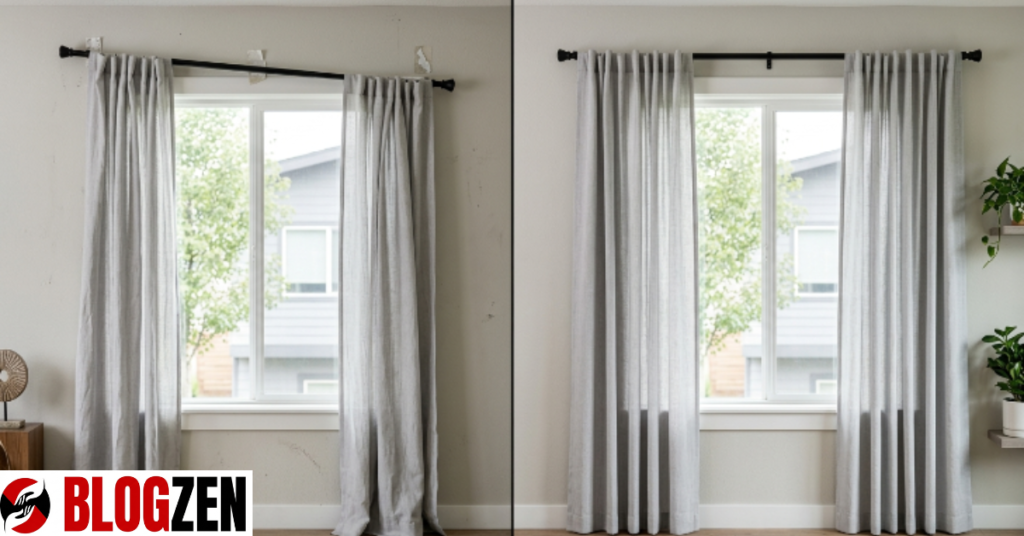
Mistake #1: Not Prepping the Wall
Dust, paint flakes, and moisture are the silent killers of adhesive bonds. Wipe your wall with a slightly damp cloth 5 minutes before applying hooks. Let it dry completely — even slight dampness reduces adhesive strength by 30%.
Mistake #2: Hanging Too Soon
Most people apply Command hooks and hang the rod after 5 minutes. The adhesive reaches only 50% strength at that point. Wait the full 30 minutes (or 24 hours for brackets). That’s the difference between a rod that holds for years and one that falls on your head.
Mistake #3: Choosing the Wrong Method for Your Curtain Weight
A 12-lb thermal curtain needs at least three heavy-duty Command hooks or a magnetic rod — not a single hook or adhesive putty. Weigh your curtains first. Hang them from a luggage scale to know exactly what you’re working with.
Mistake #4: Using Damaged or Old Hooks
Adhesive strips lose strength over time, especially if exposed to temperature fluctuations. In humid climates, they degrade faster. If you’re reusing old hooks, test them on a small weight first. When in doubt, replace them — hooks cost $2 each. Wall repair costs $50+.
Mistake #5: Forgetting the Release Tab
Command strips include a small pull-tab that makes removal easy. Many people throw it away. Don’t. When you need to move the rod, that tab is the difference between clean removal and gouged drywall.
Pro Tip: Buy one hook more than you think you need. If the first rod install doesn’t look level, having a spare hook means you can adjust without buying another set.
Expert Strategies: The Pro Installation Checklist
Before you hang anything:
- Measure twice. Find the center of your window. Mark it lightly with a pencil.
- Check the weight. Place your curtain rod on a kitchen scale. The actual weight matters — not the package estimate.
- Calculate hook placement. For a 60-inch rod, place hooks at 12 inches and 48 inches from the wall end. For heavier rods, space hooks every 20 inches.
- Test the adhesive surface. Apply one hook to an inconspicuous spot on your wall. Wait 24 hours. Pull down hard. If it holds, proceed to the full install.
During installation:
- Use a level. Measure from the top of your window to the hook placement point. Repeat on both sides. Even 1/2 inch of slant is visible.
- Install one side first. Let it cure fully before adding the opposite side. This prevents the rod from tilting while adhesive sets.
- Use the lowest-weight hook that handles your curtain weight. Extra-heavy hooks aren’t stronger — they’re overkill and unnecessary.
Real-World Case Study: From Falling Rods to Stable Curtains
Sarah rented a one-bedroom in Dallas with pristine walls. She bought a 72-inch curtain rod for her bedroom but couldn’t drill. Her first attempt used two Command hooks rated for 3 lbs each — total capacity, 6 lbs. Her thermal curtains weighed 8 lbs.
Result? The left side drooped within a week. The right side held, but uneven tension pulled the rod down at an angle.
Her second attempt: She tested the actual curtain weight using a luggage scale (revealed 8.5 lbs, not her estimate). She bought four heavy-duty Command strips (12 lbs each, 48 lbs combined). She spaced them at 18-inch intervals. After proper curing time, the rod stayed perfectly level for two years — through a move, a room redesign, and a roommate change.
The lesson? Right method, right weight capacity, and patience pay off.
What to Avoid: Myths vs. Reality About No-Drill Hanging
Myth #1: “Adhesive strips destroy walls.”
Reality: Damage-free adhesive (3M Command, GripStrip, etc.) removes cleanly. Standard masking tape or duct tape? Yes, that damages walls. But true damage-free strips leave no residue on painted drywall.
Myth #2: “Tension rods fall out immediately.”
Reality: Tension rods fail when placed in spaces too wide or too narrow for their range. A properly-sized rod stays locked for years. The issue is operator error, not the product.
Myth #3: “Hanging curtains without drilling looks cheap.”
Reality: Properly hung curtains look identical whether they’re drilled, adhered, or tensioned. The installation method is invisible once curtains are up. The only tell is if the rod sags — which happens with poor installation, not with no-drill methods.
Myth #4: “You can only hang light curtains without drilling.”
Reality: Heavy thermal, blackout, and velvet curtains (12–15 lbs) hang safely without drilling if you use the right method and weight capacity. Three adhesive hooks or a magnetic rod handles 15 lbs easily.
Step-by-Step Installation for Command Hooks (Most Popular Method)
Time required: 10 minutes active time + 30 minutes curing
What you need:
- Heavy-duty Command strips (one pair per 8 lbs of curtain weight)
- Your curtain rod
- A level
- A pencil
- Rubbing alcohol (optional, for wall cleanup)
Step 1: Measure and mark hook placement using a level. Mark the wall lightly with pencil.
Step 2: Clean the wall where hooks will go. Use a damp cloth to remove dust. Let dry completely (2–3 minutes).
Step 3: Peel the backing off one Command hook adhesive strip. Press firmly to the wall at your marked spot. Hold for 30 seconds with moderate pressure.
Step 4: Install the second hook at the opposite side, maintaining level alignment.
Step 5: Wait a full 30 minutes. Do not touch or test the hooks during this time.
Step 6: Hang your curtain rod by sliding it through the hook holders.
Step 7: Step back and verify level. If adjustment is needed, do it in the first 24 hours before the adhesive fully sets.
Conclusion
Hanging curtains without drilling isn’t a workaround — it’s the practical choice for anyone who rents, moves frequently, or values their walls. The five methods I’ve shared (adhesive strips, tension rods, magnetic rods, adhesive brackets, and putty) cover every situation, from lightweight temporary hangings to heavy blackout drapes.
The three essential takeaways:
- Match method to weight. Weigh your curtains. Choose the method rated for that weight. Cheap shortcuts fail; right-sized solutions last years.
- Prep matters more than product. A clean, dry wall with proper curing time beats expensive hooks applied carelessly. The cheapest Command strips, installed correctly, outperform premium putty installed wrong.
- Test before full commitment. Hang one hook for 48 hours before installing the entire rod. That small investment prevents disasters.
Your curtains are hanging right now — level, secure, and without a single wall puncture. Your security deposit is safe. Your walls are pristine. And next time someone asks, “How did you hang those without drilling?” you’ll have the answer.
What method will you try first? Comment below — I want to know what worked for your space.
FAQs
What is the weight limit for adhesive command strips when hanging curtains?
Heavy-duty Command strips hold up to 12 lbs per pair (two hooks). Standard strips max out at 3 lbs. For curtain rods, one pair of heavy-duty strips supports light to medium curtains. Thermal or blackout drapes (8–12 lbs) require two pairs spaced properly. Always test by hanging the actual rod first, then adding curtains gradually to verify the installation holds under real load.
Can tension rods hold heavy curtains without drilling?
Yes, if properly sized. Heavy-duty tension rods are rated for 15–20 lbs, enough for most thermal or blackout curtains. The key is matching the rod size to your window width — too loose and it spins, too tight and it applies extreme pressure. Tension rods work best in window frames where walls are parallel and relatively close (under 72 inches apart). Test by gently twisting the rod once installed; minimal movement means it’s secure.
How long do no-drill curtain hanging methods actually last?
Damage-free adhesive strips last 3–5 years on painted drywall before losing grip (humidity and temperature fluctuations speed degradation). Tension rods last indefinitely if properly installed — springs rarely fail. Magnetic rods last as long as magnets remain strong, typically 10+ years. Adhesive putty lasts 6–12 months in normal conditions. Replace hooks proactively every 2–3 years in humid climates; annual replacement isn’t usually necessary in dry climates.
What wall surfaces work best for adhesive strips hanging curtains?
Painted drywall is ideal — adhesive bonds strongest to smooth, clean surfaces. Tile, glass, and metal also work well. Avoid textured or popcorn ceilings, wallpaper, and unprimed drywall. Brick and concrete are problematic because adhesive can’t penetrate porous surfaces effectively. Test the surface in an inconspicuous spot first. If your walls are unusual, call the manufacturer — 3M Command has a customer service line for specific surface questions.
How to hang curtains without drilling in apartments with thick walls or plaster?
Plaster walls require gentler treatment because adhesive strips can pull off surface layers. Use the lowest-weight method necessary — tension rods, magnetic rods (if metal frames exist), or minimal hooks. For heavier curtains, rely on tension rods fitted inside window frames rather than wall-mounted hooks. If you must use adhesive on plaster, test one hook first, wait 48 hours, and monitor it daily for the first week to catch early failures before catastrophic damage occurs.
Are adhesive strips for hanging curtains removable without damaging paint?
Damage-free adhesive strips are specifically designed for clean removal without paint damage. The 3M Command pull-tab method is the standard — pull straight down slowly, and adhesive removes without peeling paint. Occasionally, cheap imitation strips can pull paint off. Stick to branded, damage-free products (Command, GripStrip, similar). On freshly painted walls (less than 30 days old), wait longer before installation; new paint is more vulnerable to adhesive bonding. Test removal in an inconspicuous spot if uncertain.
