



The real guide to dressing sharp, feeling confident, and never second-guessing your outfit again.
Quick Answer
Business casual outfits for women sit between formal corporate wear and everyday casual — think tailored trousers, blouses, midi skirts, and clean blazers. The key is polished yet approachable. No jeans with holes, no formal suits required. A well-fitted outfit in neutral or muted tones almost always works.
Most women have stood in front of their closet on a Monday morning thinking, “I have nothing to wear” — even with a wardrobe full of clothes. Here’s the uncomfortable truth: it’s not a clothing shortage. It’s a clarity problem. The term business casual outfits for women is one of the most misunderstood dress codes in the modern workplace, and the confusion is costing women real confidence every single day.
According to a 2023 LinkedIn survey, over 61% of working women said they felt unsure about what “business casual” actually meant for their industry. That’s not a personal failure — it’s a sign that the rules were written vaguely on purpose, leaving too much room for interpretation.
This guide changes that. By the time you finish reading, you’ll know exactly what to wear, what to skip, how to build a capsule wardrobe that works Monday through Friday, and how to adapt your look across different industries and occasions. No fluff. No vague advice. Just a clear, actionable breakdown that respects your time and your intelligence.
What Business Casual Really Means for Women (And Why It Matters Now)
The phrase “business casual” was coined in the 1990s when Silicon Valley companies started pushing back against strict corporate dress codes. It gave workers permission to loosen up — but nobody defined the boundaries clearly. For men, khakis and a polo became the shorthand. For women, the definition was left deliberately wide open.
Today, business casual for women means clothing that is professional enough for a client meeting but relaxed enough for a creative brainstorm. It’s the sweet spot between a full suit and your weekend jeans. Think of it as: polished-casual, not casual-casual.
Why does this matter in 2025? Because hybrid work has shifted the norms significantly. You might be on a Zoom call from home in the morning and walking into a client presentation in the afternoon. Your wardrobe needs to do both jobs — and understanding the real rules of business casual gives you that flexibility without a daily crisis.
Pro Tip: When you’re unsure about a new workplace’s dress code, look at what the most senior women in the office wear on a Tuesday. That’s usually the clearest signal of what “business casual” means in that specific environment.
The Anatomy of a Perfect Business Casual Outfit
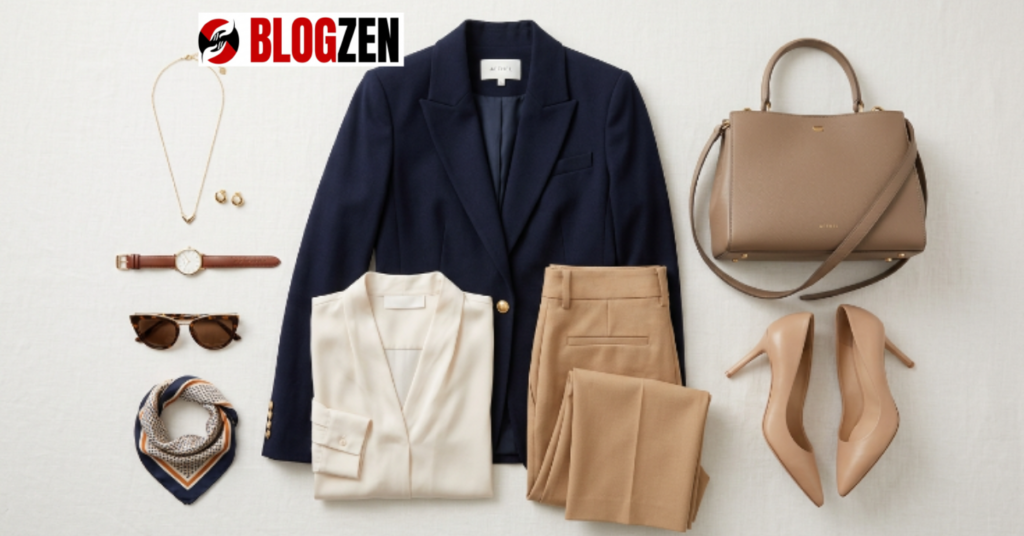
Here’s what nobody tells you: business casual isn’t about specific pieces — it’s about how pieces work together. You can wear jeans and still look business casual. You can wear a blazer and still look too casual. The magic is in the combination and the fit.
The Core Building Blocks
Every reliable business casual outfit for women is built around three elements: a structured top, a tailored bottom, and a finishing layer. Get these three right, and you’ll nail the look 90% of the time.
Structured tops include silk or satin blouses, fitted turtlenecks, button-down shirts, and knit tops with a clean cut. Tailored bottoms include well-fitted trousers, midi skirts, A-line skirts, and dark-wash straight-leg jeans (in more relaxed workplaces). Finishing layers are blazers, structured cardigans, or tailored jackets that bring the whole look together.
The Fit Rule That Changes Everything
One perfectly fitted outfit beats five poorly fitting ones. Research from the Journal of Experimental Social Psychology found that wearing well-fitted, professional clothing increases abstract thinking and confidence — not just in perception, but in measurable performance. Your clothes are working for you or against you, whether you realize it or not.
Pro Tip: Invest in a tailor for your most-worn work pieces. A $15 hem or waist-take-in can make a $40 pair of trousers look like they cost $200. The difference is visible.
| Item | Business Casual ✓ | Too Casual ✗ | Too Formal ✗ |
|---|---|---|---|
| Trousers | Tailored wide-leg or straight-leg | Joggers or cargo pants | Rigid formal suit trousers |
| Tops | Silk blouse, fitted knit | Graphic tee, crop top | Stiff formal blouse with brooch |
| Skirts | Midi A-line, pencil skirt | Mini skirt, denim skirt | Floor-length formal gown |
| Dresses | Wrap dress, shirt dress | Sundress, slip dress | Cocktail/evening dress |
| Shoes | Block heels, loafers, clean flats | Flip-flops, worn-out sneakers | Stilettos over 4 inches |
| Outerwear | Blazer, tailored cardigan | Hoodie, denim jacket | Heavy overcoat worn inside |
Best Blazers for Women Under $100 That Actually Fit
Common Mistakes Women Make With Business Casual (And How to Fix Them)
Most people get this completely wrong — not because they lack style, but because they’re working with outdated mental models. The biggest mistake? Treating business casual as a single, universal standard when it’s actually contextual.
Mistake 1: Dressing for the Office You Used to Work In
A finance firm in London has a completely different definition of business casual than a tech startup in Austin. The fastest fix is to calibrate your wardrobe to your current workplace culture, not the dress code from your last job. Wear your most neutral, classic pieces on day one, then observe and adjust within the first two weeks.
Mistake 2: Ignoring Color Psychology
Dark navy, charcoal, camel, and burgundy project authority and competence in professional settings. Neon, heavy prints, and oversaturated colors — even when worn in technically appropriate pieces — can shift attention from what you’re saying to what you’re wearing. The goal is for your outfit to support you, not compete with you.
Mistake 3: Neglecting the Shoe Decision
Shoes can elevate or completely undo an otherwise polished look. A tailored midi skirt with a ratty old sneaker reads as careless. The same skirt with a clean block heel or leather loafer reads as intentional and put-together. You don’t need expensive shoes — you need clean, well-maintained ones that match the energy of your outfit.
Pro Tip: Keep a small shoe brush and leather conditioner at your desk or in your car. A 60-second buff before you walk into an important meeting takes a shoe from “okay” to “polished” instantly.
Expert Tips and Style Strategies That Actually Work
The women who look effortlessly professional every day aren’t doing more work than everyone else — they’re doing smarter work. Their secret usually comes down to a few consistent habits.
The 3-Piece Formula
Style professionals often recommend what’s called the “3-piece formula” for building fail-proof business casual outfits. Pick one statement piece, one neutral piece, and one texture element. For example: a camel blazer (statement), black tailored trousers (neutral), and a silk blouse with subtle texture (element). This formula prevents outfits from looking either too bland or too chaotic.
Build a 10-Piece Core Wardrobe
Research from fashion psychologists suggests that decision fatigue around clothing choices can reduce cognitive performance by up to 10% throughout the workday. The fix is a curated core wardrobe where every piece works with every other piece. Ten high-quality, versatile items can realistically produce over 30 distinct outfits.
Your 10-piece business casual starter kit: white blouse, black tailored trousers, navy blazer, camel midi skirt, white fitted turtleneck, straight-leg dark jeans (for casual-leaning workplaces), grey knit cardigan, wrap dress in a solid color, black loafers, and one pair of block-heel ankle boots.
Pro Tip: Before discarding any item from your wardrobe, ask: “Does this piece work with at least three other things I own?” If the answer is no, it doesn’t belong in a functional business casual wardrobe, regardless of how much you love it in isolation.
Real-World Business Casual Looks by Industry
The truth is, “business casual” means genuinely different things depending on where you work. What reads as professional in a law firm’s Friday casual day might be what an advertising agency considers their “dressed up” standard. Let me explain why this matters practically.
Corporate Finance & Law
Here, business casual skews more formal. Tailored trousers with a silk blouse and structured blazer are the safe standard. Midi skirts in solid colors work well. Avoid anything with visible patterns or playful colors. Your jewelry should be minimal and deliberate — one or two quality pieces, not a collection.
Tech, Marketing & Creative Fields
These environments allow more self-expression. Dark-wash straight-leg jeans are almost universally accepted when paired with a polished blouse or blazer. Color and print are welcome in measured doses. Chunky loafers, fashionable sneakers in good condition, and layered pieces work here where they wouldn’t in finance.
Healthcare & Education
Practicality is the hidden priority. Midi wrap dresses, tailored trousers with comfortable but professional shoes, and minimal layers that don’t catch or restrict movement are ideal. Comfort supports performance, and that’s respected in environments where you’re on your feet or interacting with vulnerable people.
How to Build Your Business Casual Wardrobe: A Step-by-Step Guide
Stop buying random pieces that looked good in isolation on a shopping site. Building a functional business casual wardrobe requires a system — and here’s one that actually works.
- 1Audit what you already own. Pull everything out. Set aside anything that is clearly too casual (graphic tees, faded jeans, gym wear) and anything too formal (full formal suits you never wear). What’s left is your starting point.
- 2Identify your gaps. Most women find they’re missing a reliable blazer, at least two pairs of tailored trousers, and one versatile dress. These are the high-return investments to prioritize.
- 3Shop neutrals first. Black, navy, white, grey, and camel are your foundation colors. These work together effortlessly, minimizing outfit-building mental effort on weekday mornings.
- 4Add color and personality in accessories. Once your neutral base is solid, introduce color through a structured handbag, a quality scarf, or earrings. This keeps your wardrobe flexible without requiring you to buy a dozen colored tops.
- 5Prioritize fit over brand. A $50 trouser that fits perfectly always beats a $200 designer one that gaps at the waist. Budget for alterations as part of your clothing budget, not an optional extra.
- 6Plan outfits in advance, not morning-of. Spend 10 minutes on Sunday planning three to four outfits for the week. Hang them together in your closet. This one habit eliminates 90% of weekday wardrobe stress.
Pro Tip: Take a photo of every outfit you wear and save it in a phone album called “Proven Outfits.” Within a month, you’ll have a ready reference of combinations you know work — no guesswork required on rushed mornings.
Business Casual Myths vs. Facts: Setting the Record Straight
The internet is full of conflicting advice about business casual, and some of the most repeated “rules” are simply outdated myths that are quietly damaging otherwise perfectly put-together wardrobes.
Myth: You Can Never Wear Jeans
Fact: Dark-wash, straight-leg or slim jeans without distressing are accepted as business casual in the majority of modern workplaces — particularly in tech, media, and creative industries. The key is pairing them with a structured top and elevated shoes. If your jeans look like they belong at a barbecue, they don’t belong in the office.
Myth: Business Casual Means Boring
Fact: The most stylish professional wardrobes are built on business casual principles. Structure, intentionality, and fit — the hallmarks of business casual — are the same foundations of great personal style. You can wear bold earrings, interesting textures, and confident color within business casual without ever crossing the line into unprofessional territory.
Myth: You Need to Spend a Lot of Money
Fact: Price is not a proxy for professionalism. Brands like Uniqlo, Zara, and ASOS consistently produce business casual staples that, when fitted properly and styled well, compete easily with pieces three to five times the price. The investment that pays off most is not price — it’s fit.
Final Thoughts
Here’s what it comes down to: business casual outfits for women are not a rigid checklist or a corporate gatekeeping mechanism. They’re a creative framework — a set of boundaries inside which you have enormous freedom to express your style, signal your professionalism, and show up to work feeling like yourself.
The three things worth remembering: fit beats price every time; neutrals build the foundation and accessories build the personality; and your workplace culture defines your specific version of business casual more than any style blog ever could. Start there, and everything else becomes easier.
Now here’s a question for you: what’s the one piece in your current wardrobe that you’d call your most reliable business casual staple? Drop it in the comments — you might just give someone else exactly the wardrobe idea they’ve been looking for. And if you’re building from scratch, check out our guide on the 10 pieces every professional woman needs before she buys anything else.
The most powerful outfit you can wear is one that makes you forget you’re wearing it — because you feel that confident.FAQ Section
FAQs
What are the best business casual outfits for women in a corporate setting?
In a traditional corporate setting, the safest business casual choices lean more formal: tailored wide-leg or straight-leg trousers in black, navy, or charcoal paired with a silk blouse or fitted turtleneck. A structured blazer adds an immediate polish layer. Midi skirts in solid tones are equally appropriate. Avoid statement prints or bold colors until you’ve read the room clearly.
Can women wear sneakers with business casual outfits?
Yes — in certain workplaces. Clean, minimalist leather or canvas sneakers in white, black, or neutral tones are accepted in tech, creative, and startup environments when paired with tailored pieces. They’re still a risk in conservative industries like law or finance. The test: if your sneakers look like you just came from a run, they’re too casual. If they look intentional and pristine, they may work.
Are jeans considered business casual for women?
Dark-wash, undistressed straight-leg or slim jeans qualify as business casual in most modern workplaces — especially tech, media, education, and retail management. The styling matters enormously. Pair them with a structured blouse and blazer and clean shoes, and you’ll read as professional. Avoid light wash, distressed, wide-leg denim that reads casual-first. Always match your jeans’ formality level to your specific office culture.
What colors work best for business casual outfits?
The most reliable business casual palette for women builds on these foundation colors: navy, black, white, charcoal grey, camel, and burgundy. These neutrals mix effortlessly and project competence. Once your foundation is built, introduce personality through: (1) a colored blazer in dusty rose or forest green, (2) patterned accessories, or (3) a single-color dress in a muted jewel tone. Avoid neons and oversaturated prints in more conservative environments.
How do business casual outfits for women differ across seasons?
The silhouettes stay consistent across seasons, but fabrics and layering shift. In summer, opt for lightweight linen trousers, breathable silk blouses, and sleeveless structured tops. In winter, layer knit turtlenecks under blazers, add tailored wool trousers, and introduce ankle boots. Transition seasons are ideal for wrap dresses with a cardigan or a trench coat over your existing warm-weather base. The professional silhouette stays the same — only the weight changes.
What accessories complete a business casual women’s outfit?
Accessories do heavy lifting in business casual styling. A structured leather or faux-leather bag in a neutral tone (black, tan, cognac, navy) ties any look together. For jewelry, one quality statement earring or a simple necklace is more powerful than layering multiple pieces. A classic watch reads as professional across industries. Scarves tied loosely around the neck or as a bag accent add personality without risk. Keep the total accessory count to three or fewer items to maintain a clean, intentional look.
