


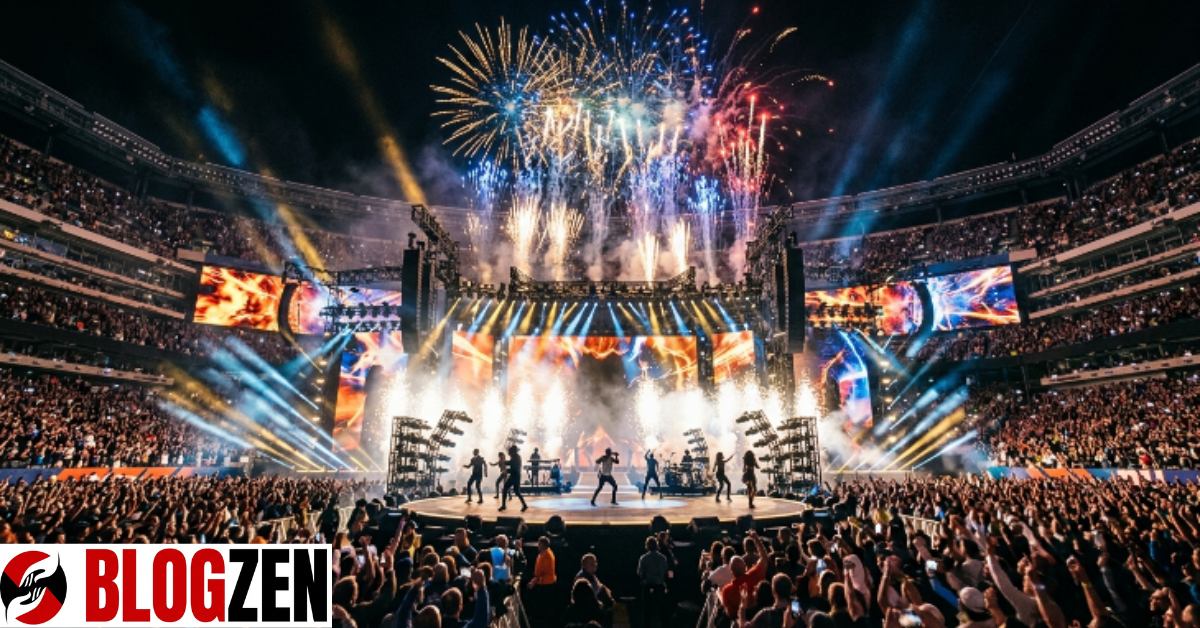
Quick Answer
The Turning Point halftime show, called the “All-American Halftime Show,” aired on February 8, 2026, opposite Bad Bunny’s official NFL Super Bowl LX halftime performance. Organized by Turning Point USA, it featured Kid Rock, Brantley Gilbert, Lee Brice, and Gabby Barrett as a self-described patriotic alternative, streamed on YouTube, Rumble, and cable via TBN and OAN.
Millions of people watched two halftime shows at the exact same moment on February 8, 2026 — and almost none of them planned it that way. While the NFL’s official Super Bowl LX halftime show brought Bad Bunny to the field, a completely separate production was streaming live on YouTube, Rumble, and two cable networks. That was the turning point halftime show, and it turned an ordinary Sunday night into a genuine cultural split-screen moment.
If you’ve been searching for what this show actually was, who performed, how it compared to the real Super Bowl halftime, and whether it’s even worth rewatching, you’re in the right place. This article breaks down exactly what happened, why it happened, and what it says about how sports, music, and politics collide in 2026.
What Is the Turning Point Halftime Show, and Why Does It Matter?
The turning point halftime show, officially named “The All-American Halftime Show,” was created by Turning Point USA, the conservative nonprofit founded by the late Charlie Kirk. Turning Point USA planned the event to compete with the official Super Bowl halftime show, which featured Bad Bunny and was sponsored by Apple Music. It aired on February 8, 2026, at exactly the same time as the NFL’s official program.
This matters because it wasn’t just a fan reaction video or a Twitter thread. It was a full broadcast production, promoted for months, with real musical talent and real distribution deals. Turning Point USA first announced the alternative event back in October, following backlash over the NFL’s decision to book Bad Bunny.
Here’s what nobody tells you: this wasn’t just about music. Bad Bunny’s booking for the official halftime show stirred controversy primarily among conservative-leaning figures and organizations, and the singer performed his set entirely in Spanish. That single detail — the language of the performance — became the spark for an entire counter-broadcast.
Pro Tip: If you’re researching this topic for content or discussion, always separate the entertainment angle (who performed, how it looked) from the political angle (why it was created). Readers searching this keyword usually want both, but conflating them makes an article feel biased instead of informative.
How the Turning Point Halftime Show Actually Worked
Most people assume this was a small, scrappy livestream. It wasn’t. A Turning Point USA spokesperson confirmed the show was “100 percent on” and described it as a full production in an “arena setting.
The distribution plan was ambitious. Viewers could watch on TV through the Trinity Broadcasting Network and One America News Network, or stream it online through DirecTV’s free trial or YouTube TV. On top of the cable option, the show was pushed hard across social platforms. Fans were directed to Turning Point USA’s YouTube channel, The Charlie Kirk Show’s channel, X, and Rumble.
The lineup leaned heavily country and rock. Performances came from Kid Rock, Lee Brice, Brantley Gilbert, and Gabby Barrett. Before the final lineup was locked in, there had been public speculation about bigger names. Online chatter floated the possibility of Creed and Nicki Minaj joining, since both had appeared at Turning Point USA’s AmericaFest event in Phoenix the previous December. Neither ended up performing.
The key takeaway: this wasn’t an improvised protest — it was a coordinated media event with a real budget, a real venue setup, and a multi-platform release strategy.
Common Mistakes People Make When Talking About This Show
The biggest mistake? Assuming it was a total flop with zero audience. That’s not accurate — but the execution did stumble in a very public way.
One real problem hit before the show even started. Turning Point had promised a stream on X, but the platform reportedly pulled the plug hours before kickoff, citing licensing issues. That’s a technical and PR mistake worth noting if you’re covering live-event broadcasting: promising a platform you haven’t fully locked in is a recipe for last-minute chaos.
Another mistake people make is assuming this event was purely spontaneous fan pushback. In reality, it was announced months in advance with a structured rollout, including audience surveys. A survey on the event’s website asked respondents to choose preferred genres, including country, hip-hop, rock, or simply “anything in English.”
The third common mistake is treating the reception as uniformly one thing — either a total win or a total disaster. Reviews and audience reactions were genuinely split, and pretending otherwise flattens what actually happened.
Expert Tips for Understanding the Bigger Picture
Think of it this way: the turning point halftime show is really a case study in modern audience fragmentation. Instead of one shared cultural moment, viewers increasingly get to pick the version of an event that matches their values.
Tip 1 — Watch the platform strategy, not just the performers. The choice to lean on TBN, OAN, YouTube, and Rumble tells you exactly who the intended audience was, separate from who actually showed up on stage.
Tip 2 — Read reactions from multiple sides before forming an opinion. Coverage of the event ranged from genuinely enthusiastic to sharply critical. At least one reviewer described the production as underwhelming compared to expectations, while some viewers who attended or watched felt it delivered exactly the “unapologetically American” tone they wanted. Both reactions are part of the real story.
Tip 3 — Separate the artists from the organizers. Performers like Brantley Gilbert publicly framed their choice to participate as a matter of personal rights and free expression, distinct from the organization’s broader political goals.
Pro Tip: When writing or discussing politically charged entertainment stories, always attribute strong opinions to named sources rather than stating them as settled fact. It protects your credibility and keeps the piece balanced.
Real-World Reactions: What People Actually Said
The split reaction is the most interesting part of this whole story. On one side, some coverage was blunt. One review described the broadcast as underwhelming and noted the show struggled with technical hiccups, including the last-minute loss of its planned X livestream.
On the other side, supporters framed it as a values statement, not a ratings competition. The event’s announcement tied the show directly to a contrast with the NFL’s official halftime performance, positioning it as an alternative rather than a replacement.
The controversy that fueled all of this traces back to the original booking decision. President Donald Trump publicly criticized the choice of Bad Bunny and Green Day for Super Bowl LX, calling himself “anti-them” and describing the selection as a decision that would “sow hatred.” That single comment amplified the story well beyond sports media into general political news coverage.
The most important lesson here: a single casting decision on one of the biggest broadcasts of the year turned into a full-blown parallel media event — that’s the real power of the Super Bowl halftime slot.
Step-by-Step: How to Watch or Rewatch the Turning Point Halftime Show
If you missed it live or want to revisit the footage, here’s exactly how to find it.
- Go to YouTube. Turning Point USA directed viewers to its own YouTube and Rumble accounts for the broadcast. Search “Turning Point USA All-American Halftime Show” directly.
- Check Rumble as a backup platform, since it was one of the confirmed distribution channels alongside YouTube.
- Try TBN or OAN on-demand libraries if you have cable access, since both networks aired the live broadcast.
- Skip X/Twitter for the original live version — that stream reportedly never went live due to last-minute licensing issues.
- Search recap articles and video roundups from entertainment outlets if you want a shorter, edited version of the highlights.
Myths vs. Facts About the Turning Point Halftime Show
There’s a lot of noise around this event, so let’s separate what’s confirmed from what’s just chatter.
Myth: The show never actually aired. Fact: It did air, on schedule, on February 8, through TV and streaming platforms — just not through the X livestream that was originally promised.
Myth: It was a low-budget fan project. Fact: Organizers described it as a full arena-style production with a confirmed lineup, sponsorship push, and multi-platform release.
Myth: Every review of the show was negative. Fact: Reception was mixed — some viewers and commentators embraced it as exactly what they wanted, while other reviewers were critical of the execution and production value.
Quick Comparison: Official Super Bowl Halftime vs. Turning Point Halftime Show
| Feature | Official NFL Halftime Show | Turning Point Halftime Show |
|---|---|---|
| Headliner | Bad Bunny | Kid Rock |
| Supporting Acts | Multiple guest performers | Lee Brice, Brantley Gilbert, Gabby Barrett |
| Sponsor | Apple Music | Turning Point USA |
| Primary Platforms | NBC broadcast, Peacock | YouTube, Rumble, TBN, OAN |
| Venue | Levi’s Stadium (live game) | Separate arena-style production |
| Tone | Mainstream, multilingual | Patriotic, country/rock-leaning |
Conclusion
The turning point halftime show wasn’t a fringe stunt — it was a fully produced, multi-platform broadcast built specifically to compete with one of the biggest entertainment moments of the year. It drew real performers, real viewers, and real controversy, and its reception was genuinely split rather than uniformly positive or negative.
The bigger story here isn’t really about music. It’s about how a single casting decision on America’s biggest stage can fracture an audience into two competing broadcasts happening at the exact same second.
So here’s the real question worth thinking about: as more “alternative” broadcasts pop up around major cultural events, are we heading toward a future where there’s no single shared moment left at all? Drop your take in the comments — and check out our breakdown of the official Super Bowl LX halftime show for the other side of the story.
FAQs
What is the Turning Point halftime show?
It’s “The All-American Halftime Show,” produced by Turning Point USA and aired on February 8, 2026, at the same time as the NFL’s official Super Bowl LX halftime show. It was created as a patriotic, alternative broadcast, featuring country and rock performers, and distributed across streaming and cable platforms.
Who performed at the Turning Point halftime show?
The confirmed lineup included Kid Rock, Lee Brice, Brantley Gilbert, and Gabby Barrett. Earlier speculation suggested Creed and Nicki Minaj might join, based on their past appearances at a related Turning Point USA event, but neither artist was confirmed as part of the final show.
Where can I watch the Turning Point halftime show?
You can find it primarily through:
- YouTube — Turning Point USA’s official channel
- Rumble — listed as a confirmed streaming partner
- Cable — via Trinity Broadcasting Network or One America News Network
The originally planned X livestream did not go live as intended.
Why did Turning Point USA create its own halftime show?
The event was created largely in response to backlash over Bad Bunny headlining the NFL’s official Super Bowl LX halftime show, particularly around his history of political statements and his performance being delivered in Spanish. Turning Point USA positioned its show as a patriotic counter-programming option.
Was the Turning Point halftime show successful?
Reception was mixed rather than clearly positive or negative. Some reviewers criticized the production quality and noted technical issues, including the loss of the planned X stream, while other viewers and participating artists described the event as delivering the patriotic tone they were hoping for.
How does the Turning Point halftime show compare to the official Super Bowl halftime show?
The two events differed sharply in scale, sponsorship, and audience. The NFL’s official show, sponsored by Apple Music and headlined by Bad Bunny, aired to the show’s massive built-in Super Bowl audience, while the Turning Point version relied on streaming platforms and conservative-leaning cable networks to reach its audience. VISIT BLOGZEN
