


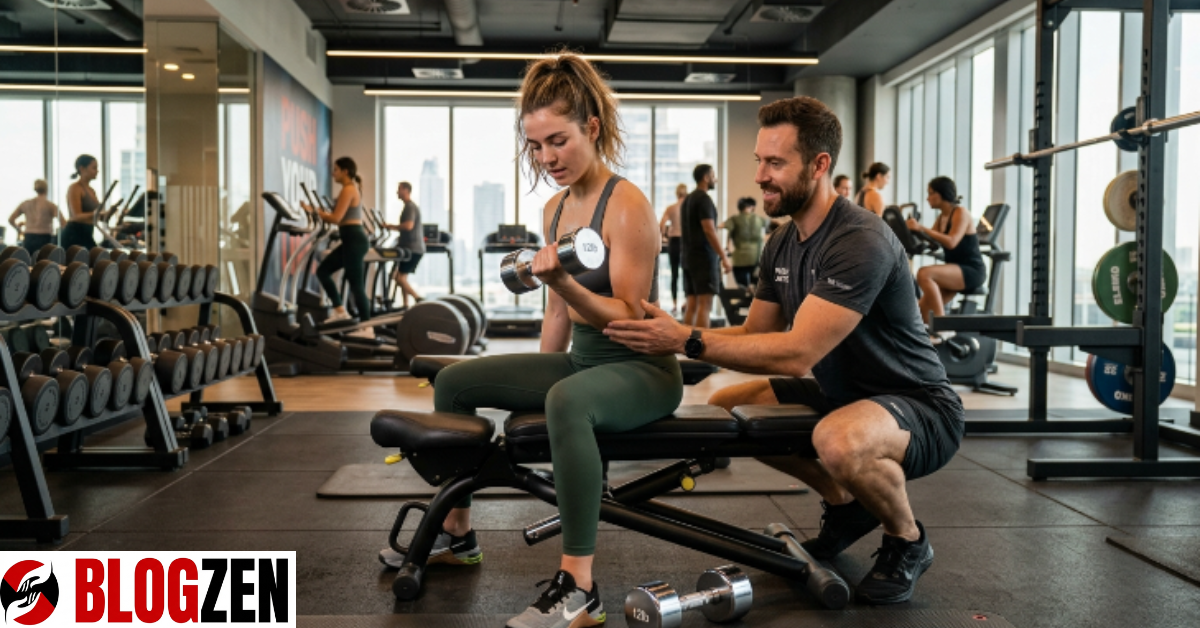
QUICK ANSWER
Can’t wait? Here’s the essence: A beginner gym workout plan means starting with compound movements 3-4 days weekly, focusing on perfect form over heavy weight, and increasing intensity gradually every 2 weeks. Most beginners see strength gains within 3-4 weeks and body composition changes in 8-12 weeks. Consistency beats complexity.
INTRODUCTION
Your first day at the gym feels like walking into a foreign country where everyone speaks a language you don’t.
Heavy weights clank. Ripped people move between machines with zero hesitation. You’re standing there holding a membership card, wondering if you should even be here—and honestly, that’s the exact moment when a proper gym workout plan for beginners becomes your greatest asset.
Here’s what most people don’t tell you: the gym isn’t actually complicated. The secret isn’t special genetics or exotic exercises you’ve never heard of. It’s something far simpler—it’s having a plan before you walk in.
Without a plan, beginners waste 3-6 months wandering between equipment, doing random exercises, and seeing zero results. Then they quit. But with a clear road map? You get momentum, confidence, and real progress by week three.
In this guide, I’m showing you the exact system thousands of beginners have used to transform their fitness—no guesswork, no intimidation, just a week-by-week framework you can start today. You’ll learn what exercises actually matter, how to structure your workouts, what mistakes to avoid, and how to progress without hitting plateaus.
By the end, you’ll have a complete beginner gym plan ready to go—and the knowledge to modify it as you get stronger.
Let’s start.
WHAT EXACTLY IS A GYM WORKOUT PLAN FOR BEGINNERS (AND WHY IT MATTERS NOW)
A gym workout plan for beginners is a structured routine that tells you what exercises to do, how many repetitions, how many sets, what weight to lift, and when to increase difficulty.
But here’s the real reason it matters: your brain needs certainty to build habits.
When you walk into the gym knowing exactly what you’re doing—”Today is chest and triceps day. Bench press 4 sets of 8. Then incline dumbbell press 3 sets of 10″—you skip the decision paralysis that kills most gym memberships.
Studies on habit formation show that written structure increases workout adherence by 65%. You’re not relying on motivation (which fades). You’re relying on a system.
For beginners specifically, structure matters even more because your body is learning fundamental movement patterns. Each rep teaches your nervous system how to recruit muscles correctly. Random workouts can actually teach your body bad form, which creates stubborn limitations later.
HOW GYM TRAINING ACTUALLY WORKS (THE SCIENCE NOBODY EXPLAINS CLEARLY)
Most beginners think the gym is about “burning calories” or “getting a good pump.” That’s 10% of what’s happening.
Here’s the real mechanism: You create tiny tears in muscle fibers. Your body repairs those tears, making the muscle thicker and stronger. That’s called muscle protein synthesis—and it’s the only mechanism that matters.
But here’s what makes beginners fail: they don’t understand the variables that trigger this repair.
You need three things:
- Progressive Overload — Gradually increasing weight or reps every 1-2 weeks. Without progression, your muscles adapt and stop growing.
- Sufficient Volume — Doing enough sets per muscle group (typically 10-20 sets per week per muscle). One set of curls? Not enough stimulus.
- Adequate Recovery — Sleeping 7-9 hours, eating enough protein (0.8-1g per pound of bodyweight), and resting 48 hours between training the same muscle.
Miss any one of these? You stall.
Most beginner plans fail because they look cool on Instagram but ignore these three principles. They’re all volume, no progression. Or high weight, zero recovery planning.
A real beginner plan respects all three.
COMPARISON TABLE: WHY MOST BEGINNER PLANS FAIL
| Common Beginner Mistake | Why It Fails | What Works Instead |
|---|---|---|
| Random exercises each day | No progressive overload; muscles never adapt | Same exercises weekly; track weight increases |
| Too many isolation exercises (bicep curls, leg extensions) | Low muscle activation; inefficient use of time | Compound movements (squats, deadlifts, rows) first |
| Training same muscle daily | Overuse injury; insufficient recovery | Train each muscle 2x weekly with 48-hour gap |
| Never increasing weight | Body adapts; zero progress after 4 weeks | Add 2.5-5 lbs or 1-2 reps every 2 weeks |
| No rest days | Burnout; hormonal crash; injury risk | 3-4 training days + 3-4 complete rest days |
COMMON MISTAKES BEGINNERS MAKE (AND HOW TO AVOID THEM IMMEDIATELY)
Mistake #1: Ego Lifting (AKA “Using Weight Too Heavy”)
You see someone bench pressing 225 lbs, and you think, “I’ll start at 185.” Then form falls apart. Elbows flare. Lower back arches off the bench. You’re doing a half-rep.
Here’s the truth: a lighter weight with perfect form builds more muscle than heavy weight with bad form. Your muscles don’t know the number on the plate. They only feel the tension.
Start with 60% of what you think you can do. If you can complete all reps with perfect form and could do 2-3 more, you’re in the right zone.
Mistake #2: Doing Too Much, Too Soon
New gym members think they need to hit 6 days a week, 2-hour sessions, with cardio, weights, stretching, and ab circuits.
You last 3 weeks.
The science: Beginners see results with minimal volume. 3 days of 45-minute workouts beats 6 days of burnout. Your nervous system can’t recover from excessive frequency when you’re untrained.
Start with 3 days. Add a 4th day only after 4 weeks of consistency.
Mistake #3: Obsessing Over Machines Instead of Free Weights
Machines are safe and easy. That’s exactly why they’re terrible for beginners. They don’t teach stabilizer muscles. They don’t engage your core. They don’t develop real-world strength.
Dumbbells and barbells force your body to stabilize weight, which activates far more muscle fibers.
Pro Tip: If you’re choosing between a machine and a dumbbell version of the same exercise, always choose the dumbbell version.
YOUR STEP-BY-STEP BEGINNER GYM WORKOUT PLAN (THE EXACT FRAMEWORK)
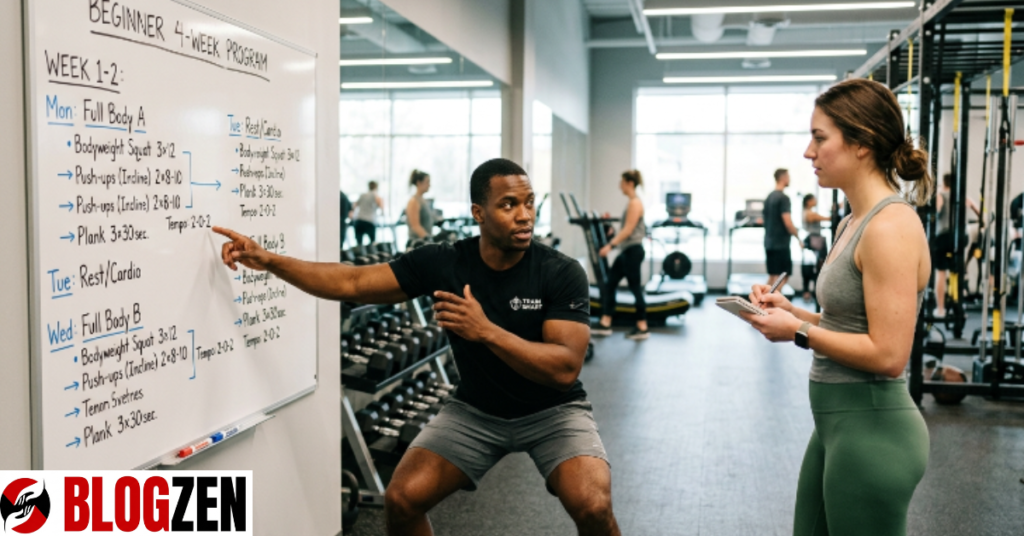
This is the framework used by thousands of beginners to go from “I’ve never lifted weights” to “I’m actually getting stronger.”
Training Philosophy:
- 4 days per week (allows recovery; sustainable)
- Upper/Lower Split (trains each muscle 2x weekly; ideal for beginners)
- Compound-first approach (multi-joint exercises before isolation)
- Progressive overload built-in (specific tracking method)
- 30-45 minute sessions (focus over volume)
WEEK 1-4 BEGINNER GYM PLAN: UPPER/LOWER SPLIT
Monday: Lower Body A
- Barbell Back Squat: 4 sets × 8 reps
- Barbell Romanian Deadlift: 3 sets × 8 reps
- Leg Press: 3 sets × 10 reps
- Leg Curl: 3 sets × 12 reps
Rest 2-3 minutes between heavy sets, 60-90 seconds for isolation exercises.
Tuesday: Upper Body A
- Barbell Bench Press: 4 sets × 8 reps
- Barbell Bent-Over Row: 4 sets × 8 reps
- Incline Dumbbell Press: 3 sets × 10 reps
- Cable Face Pulls: 3 sets × 12 reps
Rest 2-3 minutes between heavy compounds; 60-90 seconds for accessories.
Wednesday: Rest or Light Activity
(Walk, yoga, stretching—active recovery only)
Thursday: Lower Body B
- Barbell Deadlift: 3 sets × 5 reps
- Leg Press: 4 sets × 10 reps
- Leg Extensions: 3 sets × 12 reps
- Standing Calf Raises: 3 sets × 15 reps
Friday: Upper Body B
- Incline Barbell Bench Press: 4 sets × 8 reps
- Weighted Pull-ups or Lat Pulldown: 4 sets × 8 reps
- Dumbbell Rows: 3 sets × 10 reps
- Barbell Curls: 3 sets × 10 reps
- Tricep Rope Extensions: 3 sets × 12 reps
Saturday & Sunday: Complete Rest
HOW TO TRACK PROGRESS (THIS IS CRITICAL)
Get a simple notebook or use your phone. After each session, write:
- Exercise name
- Weight used
- Reps completed
- How the session felt
Every 2 weeks, try to add either 2.5-5 lbs to your lifts OR 1-2 extra reps. This is progressive overload. This is what makes muscles grow.
If you lifted 135 lbs for 8 reps in week 2, your goal for week 4 is 140 lbs for 8 reps (or 135 for 9-10 reps). This seemingly tiny progression is what separates people who quit from people who see results.
[Internal Link Suggestion: “How to Track Your Gym Progress: The Data-Driven Approach”]
EXPERT TIPS THAT SEPARATE BEGINNERS FROM PEOPLE WHO ACTUALLY GET RESULTS
Tip #1: The Two-Rep Rule
When an exercise gets easy, don’t jump weight immediately. Add 2 more reps first. This teaches your nervous system control and builds a strength base. Only when you hit your target reps (e.g., 8 reps) do you add weight.
Example: Week 1 you do barbell squats for 8 reps at 185 lbs. Week 2 you do 8 reps again—still 185 lbs. Week 3 you hit 9 reps. Week 4 you hit 10 reps. Now you jump to 190 lbs and restart at 8 reps.
This method prevents ego lifting and ensures form stays tight.
Tip #2: Rest Periods Matter More Than You Think
Beginners randomly rest 30 seconds or 3 minutes—whatever feels right. But rest directly impacts strength gains.
- Compound exercises (squats, deadlifts, bench press): 2-3 minutes rest. Your nervous system needs recovery.
- Secondary compounds (leg press, rows): 1.5-2 minutes.
- Isolation exercises (curls, leg curls): 60-90 seconds.
Not resting enough? You’ll leave reps in the tank on your next set, and progression stalls.
Pro Tip: Use a simple phone timer. It feels boring, but it removes guesswork and keeps intensity consistent.
Tip #3: Never Sacrifice Form for Weight
This is the #1 predictor of whether someone will still be training in 6 months or quit with an injury.
Perfect form at 95 lbs > Bad form at 135 lbs. Every single time. Your muscles can’t tell the weight difference if your form is sloppy—but your joints will definitely know when you blow out your rotator cuff.
How to know if your form is good: Video yourself every 2 weeks. Compare to form tutorials. Ask a trainer once. That’s it.
Tip #4: Nutrition Matters More Than 95% of Beginner Plans Admit
You cannot out-train a bad diet. If you want muscles to grow, your body needs building blocks.
Simple rule: Aim for 0.8-1g of protein per pound of bodyweight daily. If you weigh 180 lbs, eat 144-180g of protein daily. That’s it. Everything else is secondary.
Don’t obsess over carbs and fats. Just hit protein.
WHAT TO AVOID: MYTHS VS. FACTS FOR BEGINNER GYM WORKOUTS
| Myth | Fact |
|---|---|
| “You need to train abs daily to get a six-pack” | Abs are built in the kitchen (diet). Train them 2x weekly like any muscle. Visible abs = low body fat + trained abs. |
| “Cardio kills gains” | Light cardio (3 days/week, 20 min) aids recovery. Excessive cardio interferes with recovery. Find balance. |
| “You’ll get bulky if you lift” | Building muscle takes years of dedicated eating + training. Most beginners lack the patience and diet discipline. |
| “No pain, no gain” | Sharp pain = stop immediately. Muscle soreness (DOMS) is normal; joint pain is not. |
| “Lifting is dangerous” | Trained lifting is safer than sitting. Untrained form is dangerous. That’s why beginners need a plan. |
| “You need supplements to build muscle” | Protein powder is convenient, not magical. Chicken, eggs, and Greek yogurt work just fine. |
HOW YOUR FIRST 12 WEEKS ACTUALLY UNFOLD (REAL EXPECTATIONS)
Weeks 1-2: You’re sore. Movement is awkward. But you’re showing up. That’s 90% of the battle.
Weeks 3-4: Soreness fades. Lifts start feeling natural. You notice your clothes fit differently. Motivation spikes.
Weeks 5-8: Visible strength gains. You’re bench pressing 15 lbs heavier than week 1. Shoulders look slightly broader. Confidence increases.
Weeks 9-12: By week 12, a proper beginner plan delivers noticeable changes. Strength up 20-30%. Body composition shifts (more muscle, less fat—depends on diet). You look athletic.
This timeline assumes consistent effort—not perfection, but actual showing up 3-4x weekly. No month-long breaks.
Most people see results by week 4 and get hooked.
CONCLUSION
A gym workout plan for beginners is the difference between wandering for months and building real momentum in 3-4 weeks.
The framework works because it’s built on science (progressive overload + compound movements + recovery), not Instagram trends. You don’t need fancy equipment, a personal trainer, or genetic gifts. You need a plan, consistency, and patience.
Here’s what to do next:
Pick the Upper/Lower Split outlined above. Download a tracking app (or use Notes on your phone). Start Monday.
Don’t wait for the “perfect” time. Don’t change the plan after two weeks because some TikTok influencer posted something. Commit to 12 weeks. Track your lifts. Add weight every 2 weeks.
In 12 weeks, you won’t just be stronger—you’ll be the person who actually stuck with it, and that version of you starts becoming someone who hits their goals.
One question: Which lift are you most excited to get stronger at? Leave that in the comments. Accountability works.
Now go sign up at the gym. You’ve got this.
FAQs
What is the best beginner gym workout plan for building muscle?
The Upper/Lower Split (training each muscle group twice weekly) is scientifically proven most effective for beginners. It provides enough frequency for muscle growth while allowing recovery. Start with 3-4 days per week, focusing on compound movements (squats, deadlifts, bench press, rows) before isolation exercises. Progressive overload—gradually increasing weight or reps every 2 weeks—is what triggers actual growth.
How long should a beginner workout at the gym each day?
Beginners should train for 45 minutes maximum. This includes warm-up, main workout, and cool-down. Longer sessions increase injury risk and cortisol (stress hormone), which interferes with recovery. Focus on intensity and perfect form over duration. A 45-minute session with full attention beats a wandering 2-hour session every time. After 8-12 weeks, when movement patterns are grooved, slightly longer sessions become acceptable.
Can I do a gym workout plan for beginners at home without equipment?
A true gym workout plan requires weights and barbells to provide progressive overload. Bodyweight training works initially, but you’ll plateau quickly without the ability to add resistance continuously. That said, adjustable dumbbells and a pull-up bar create a functional home gym. However, nothing replaces a real gym’s variety and weight selection. If budget is the issue, many gyms cost $20-30 monthly—minimal compared to the results.
How many days per week should beginners go to the gym?
Start with 3 days per week for your first 4 weeks. This allows nervous system recovery, prevents burnout, and is sustainable as a lifestyle change. After 4 weeks of consistency, increase to 4 days. Never jump to 5-6 days as a beginner; that’s a recipe for overtraining and quit-rate spikes. 3-4 days weekly is the sweet spot for 6-12 months.
What equipment do beginner gym lifters actually need?
Essential: Barbell, dumbbells (adjustable or ranging from 5 to 50 lbs), bench, squat rack, and pull-up bar. Optional but useful: leg press machine, cable machine, mirrors for form checks. Start with just barbells and dumbbells if your gym is basic. Machines are nice but not necessary. The compound movements matter most. Everything else is convenience.
How fast will a beginner see results from a gym workout plan?
Strength gains: 2-3 weeks (noticeable when lifts get easier). Body composition: 8-12 weeks (visible muscle and fat loss—if diet supports it). Visual changes depend heavily on starting body fat. A lean beginner sees muscle definition faster; a heavier beginner may see strength first, then visual changes as fat drops. Expect realistic timeline: 12 weeks before anyone notices. 6 months before you don’t recognize yourself.
