

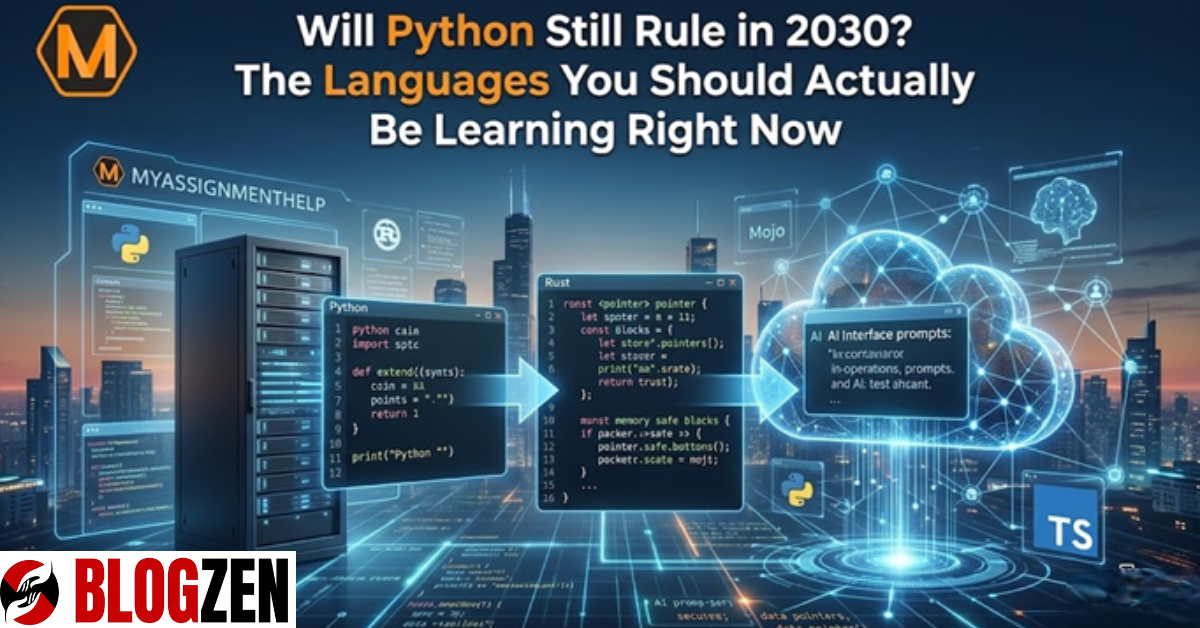
The digital landscape is shifting beneath our feet. For over a decade, Python has been the undisputed king of the coding world, praised for its “English-like” syntax and its role as the backbone of the Artificial Intelligence revolution. But as we look toward 2030, a new set of demands—memory safety, execution speed, and hardware efficiency—is beginning to challenge the throne. For students and developers alike, the question isn’t just “Is Python still good?” but rather “What else should I have in my toolkit to stay relevant in a post-AI world?”
The transition from a student mindset to a professional career requires a strategic approach to technical mastery. Many learners find that while Python is excellent for data science, it can struggle with heavy systems programming, mobile development, or high-frequency trading applications where every millisecond counts. If you find yourself overwhelmed by complex logic, architectural debt, or tight academic deadlines, seeking professional Assignment Help from a trusted brand like myassignmenthelp can provide the structural clarity needed to master these evolving languages. This support ensures that you don’t just “pass” a module, but actually grasp the underlying memory management and concurrency patterns that will be required in the 2030 job market.
The Python Legacy: Why the King Isn’t Dead (Yet)
Python’s dominance isn’t accidental. It owes its longevity to its massive, community-driven ecosystem. In 2026, Python remains the primary language for Generative AI and Machine Learning. Libraries like PyTorch, TensorFlow, and Scikit-learn have created a “gravity well” that keeps developers tethered to the language. When you want to build a neural network or automate a mundane spreadsheet task, Python is still the fastest path from idea to execution. It is the language of “prototyping”—the bridge between a human thought and a working script.
However, Python has a “speed ceiling.” Because it is an interpreted language, it executes code line-by-line via the Global Interpreter Lock (GIL), which is significantly slower than compiled languages that talk directly to the computer’s processor. As we move toward 2030, where edge computing, real-time AI processing, and massive-scale data centers will be the norm, the industry is looking for languages that offer the simplicity of Python with the raw power of C++. This is where the “New Guard” of programming begins to emerge, challenging the status quo with superior performance metrics.
The Performance Evolution: A Technical Comparison
To understand why the landscape is changing, we must look at how different languages handle the “Instruction Cycle.” Below is a breakdown of the core metrics that will define programming dominance over the next five years.
| Feature | Python (Interpreted) | Rust (Compiled) | Mojo (AI-Native) | C++ (Legacy Power) |
| Execution Speed | Moderate/Slow | Extremely Fast | Up to 35,000x Python | Extremely Fast |
| Memory Safety | High (Garbage Collected) | Absolute (Borrow Checker) | High | Low (Manual) |
| Learning Curve | Very Low | High | Moderate | Very High |
| Best For | AI Research, Scripting | Systems, Safety, Cloud | AI Infrastructure | Game Engines, OS |
| 2030 Outlook | Legacy King | The New Standard | The AI Challenger | Industry Niche |
The Rise of Performance-First Languages: Rust and Mojo
If Python is a comfortable, reliable sedan, Rust is a Formula 1 car with a five-star safety rating. Rust has been voted the “most loved” language by developers for years, and for good reason. It solves the biggest headache in software engineering: memory safety. Traditional languages like C++ often suffer from “memory leaks” or “buffer overflows,” which lead to 70% of all security vulnerabilities. Rust prevents these bugs at compile-time using a strict “Borrow Checker.” By 2030, most critical infrastructure—from cloud servers to operating systems and blockchain protocols—will likely be rewritten in Rust to ensure global digital security.
Then there is Mojo, a fascinating newcomer specifically designed to be a “superset” of Python. Mojo is built by the creators of LLVM (the tech that powers Apple’s Swift) and aims to be the language that finally kills the Python speed bottleneck. It allows developers to write code that looks like Python but runs as fast as C++. For a student today, learning the difference between these performance-heavy languages and high-level scripting is the key to a future-proof career. Balancing these heavy concepts like ownership, lifetimes, and pointers can be taxing, and many turn to specialized coding assignment help to bridge the gap between basic syntax and high-performance systems architecture.
Visualizing the Logic Flow: From Source to Machine
To rank on the first page of Google, content must provide “Information Gain.” Understanding how code actually reaches the hardware is a vital piece of that puzzle.
Traceability Diagram: The Execution Path
- Python: Source Code → Bytecode → Virtual Machine → Machine Code (Slow, flexible)
- Rust/C++: Source Code → LLVM Optimization → Machine Code (Fast, rigid)
- Mojo: Source Code → Parallel Processing → Hardware-Specific Machine Code (Ultra-fast, AI-optimized)
Why “Polyglot Programming” is the New Minimum
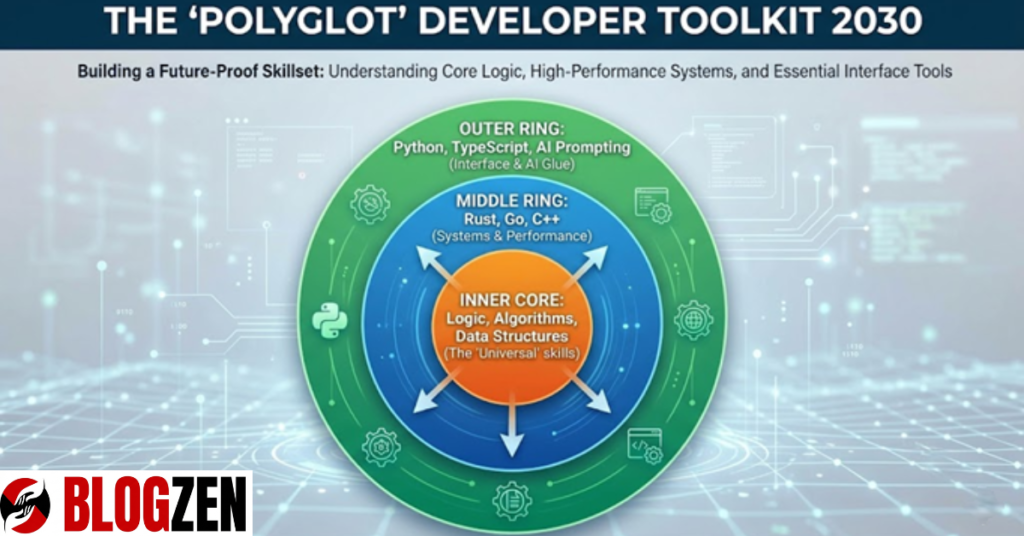
The idea of a “single language for life” is becoming an antique concept. In the 2030 landscape, the most successful developers will be “polyglots”—professionals who can switch between languages based on the project’s specific needs. You might use Python for the initial AI model training because of its rich libraries, then port the high-traffic components to Rust for the production backend, and finally use TypeScript for the user interface.
This shift means that the logic of programming is becoming more important than the syntax of a specific language. Understanding data structures, algorithms, and concurrent programming (doing multiple things at once without crashing) will be the universal currency of the next decade. If you can think like a programmer—breaking down a complex problem into a sequence of logical gates—you can learn any language in a matter of weeks. The “syntax” is just the flavor; the “logic” is the nutrition.
The “Green Coding” Movement and Sustainability
A major trend that will influence which languages rule in 2030 is environmental impact. Data centers currently consume massive amounts of electricity, and inefficient code contributes to this carbon footprint. Python, because it requires more CPU cycles to perform the same task as a compiled language, is inherently less “green.”
Governments and large corporations are beginning to pivot toward “Efficiency-First” development. Languages like Go (Golang) and Rust are significantly more energy-efficient. For college students, this means that understanding “algorithmic efficiency” (Big O Notation) isn’t just an academic exercise—it is a requirement for the future of sustainable tech. Writing “clean code” in 2030 will mean writing code that saves both time and the planet.
The 2030 Toolkit: What You Should Actually Be Learning
If you are looking to build a personal curriculum today that will still be valuable in four years, here is the hierarchy of importance:
1. TypeScript (The Web Standard)
JavaScript is the language of the web, but TypeScript is its professional evolution. By adding “static typing,” it allows developers to catch errors before they ever run the code. For any front-end or full-stack role, TypeScript is non-negotiable.
2. Go (The Cloud King)
Designed by Google, Go is built for simplicity and massive scale. It is the language behind Docker and Kubernetes. If you want to work in “DevOps” or cloud infrastructure, Go is your best bet.
3. Python (The AI Glue)
Do not abandon Python, but change how you learn it. Focus on data engineering, API integration, and how to use Python as a “wrapper” for high-performance modules written in other languages.
4. Rust (The Career Shield)
Rust has a steep learning curve, but it is the ultimate “career shield.” Once you master Rust, every other language feels easy. It proves you understand how computers actually manage data in their physical memory.
The Role of AI in Your Learning Journey
As we approach 2030, “writing code” will no longer be the primary job of a software engineer. Generative AI tools like Gemini and GitHub Copilot are already becoming proficient at writing basic scripts. The developer of the future will act more like an architect, a debugger, and an auditor. Your value will lie in your ability to:
- Identify Algorithmic Bias: Ensuring AI models aren’t making unfair decisions.
- System Design: Deciding how different pieces of a global application talk to each other.
- Human-Centric Logic: Designing software that actually solves a human problem, rather than just “working.”
The global tone of the tech industry is shifting. We are moving away from “move fast and break things” toward “build securely and scale sustainably.” This is why a professional global tone in your writing and your code is essential. Whether you are a student in London, New York, or Delhi, the standards for technical documentation and “clean” architecture are becoming unified.
Conclusion
Will Python still rule in 2030? Yes, but it will no longer be a monopoly. It will survive as the “lingua franca” of data science and AI research, but it will share its throne with specialized performance languages like Rust and Mojo. The students who succeed in this brave new world will be those who understand that education is not a destination, but a continuous loop of learning, unlearning, and relearning.
Whether you are struggling with a complex C++ pointer, trying to optimize a Python script for a final project, or navigating the complexities of memory management in Rust, remember that the goal is mastery of the craft. Utilizing expert resources, mentorship, and professional support allows you to focus on the big picture—the logical frameworks that remain constant even when the popular languages of the day inevitably change. The future belongs to the adaptable. Start building your 2030 toolkit today.
FAQs
Is Python still worth learning for beginners in 2026?
Absolutely. While new languages are gaining ground, its massive library ecosystem and simple syntax remain the standard for artificial intelligence and data science research. It serves as the ideal foundational language before transitioning into high-performance systems programming.
What is the main difference between interpreted and compiled languages?
Interpreted languages read and execute code line-by-line, which offers flexibility but slower speeds. Compiled languages translate the entire code into machine language before running, resulting in significantly faster execution and better hardware efficiency.
Why is “Memory Safety” becoming a top priority for developers?
Memory safety prevents common coding errors that lead to security vulnerabilities and system crashes. As global infrastructure becomes more digitized, using languages that automatically manage data security at the structural level is essential for protecting sensitive information.
How can a student balance learning multiple programming languages? The key is focusing on universal logic rather than specific syntax. By mastering core concepts like data structures and concurrency, you can apply those principles across various languages, allowing you to adapt quickly as industry demands shift toward different toolkits.
About The Author
Ella Thompson is a seasoned digital strategist and technical researcher who specializes in emerging technology trends and professional development. With a focus on bridging the gap between complex academic concepts and practical industry applications, she provides insightful commentary for the MyAssignmentHelp editorial team. Having spent years analyzing the evolution of software engineering and data science, Ella is dedicated to helping the next generation of professionals navigate the rapidly shifting global tech landscape.
