


Quick Answer
To dose fertilizer for plants correctly, match the fertilizer type (liquid, granular, or slow-release) to your plant’s growth stage, always dilute to half the label strength for indoor plants, and feed every 2–4 weeks during active growth. Overfeeding kills more plants than underfeeding ever will.
Most dead houseplants aren’t dying from neglect. They’re dying from love — specifically, too much fertilizer poured in with good intentions and zero math. If you’ve ever wondered why your plant’s leaves turned crispy brown right after you “helped” it grow, you’re not alone, and you’re about to find out exactly what went wrong.
Knowing how to dose fertilizer for plants isn’t about memorizing a formula. It’s about understanding what your plant actually needs, when it needs it, and how much is genuinely too much. This guide walks you through the real numbers, the mistakes almost everyone makes, and a step-by-step system you can use on literally any plant — houseplant, garden bed, or container vegetable.
By the end, you’ll know exactly how to read a fertilizer label, calculate the right dose for your pot size, and avoid the single most common mistake that burns roots and stunts growth.
What Is Fertilizer Dosing and Why It Actually Matters
Fertilizer dosing simply means giving your plant the correct amount of nutrients for its size, species, and growth stage — not the amount printed on a generic bottle label. Most fertilizer labels are written for the worst-case scenario, not your specific plant.
Here’s what nobody tells you: labels are designed by manufacturers to sell more product, not to protect your soil. A “feed weekly” instruction on a bottle often assumes outdoor conditions, mature plants, and fast-draining soil — none of which may apply to the fern sitting on your windowsill.
Getting the dose wrong doesn’t just waste money. Excess nitrogen, phosphorus, or potassium builds up as salt in the soil, which pulls moisture away from roots instead of feeding them. Under-fertilizing, on the other hand, leaves plants pale, slow, and vulnerable to pests. Both mistakes look similar on the surface, which is exactly why so many gardeners misdiagnose the problem.
READ MORE: The Truth About Starting a Balcony Garden Nobody Tells You
How Fertilizer Dosing Actually Works
Think of it this way: fertilizer isn’t food in the way we understand food. It’s closer to a mineral supplement — plants make their own energy through photosynthesis, and fertilizer just supplies the raw building blocks like nitrogen (N), phosphorus (P), and potassium (K).
Those three numbers on every bag or bottle (like 10-10-10) represent the percentage of each nutrient by weight. A 10-10-10 fertilizer is 10% nitrogen, 10% phosphorus, and 10% potassium, with the remaining 70% being filler material.
The Dilution Principle
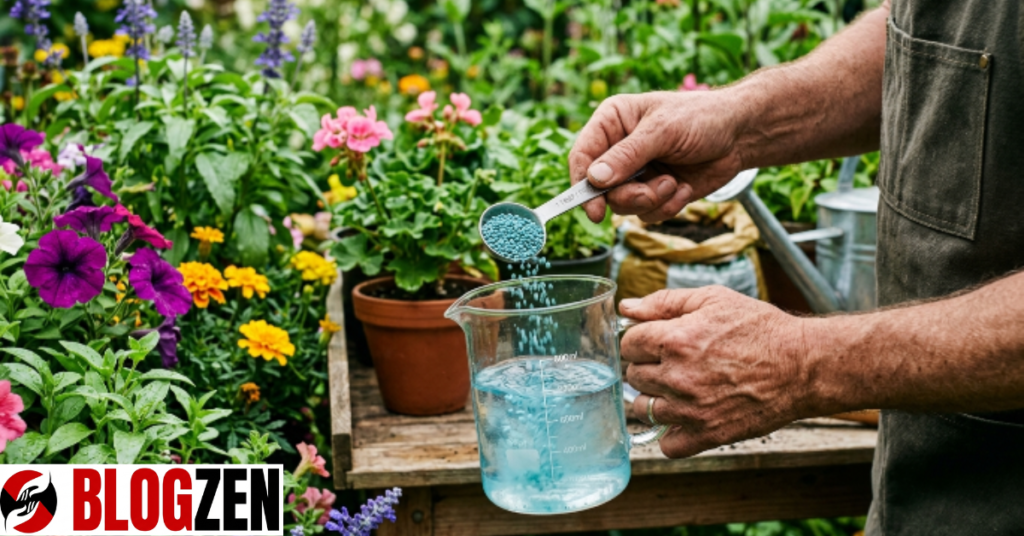
For liquid fertilizers, dosing math usually works like this:
- Check the label’s “full strength” ratio (commonly 1 tablespoon per gallon)
- Cut that ratio in half for houseplants or sensitive species
- Apply only to already-moist soil, never dry soil
The core takeaway here: diluting to half-strength and feeding more frequently is almost always safer than full-strength feeding on the label’s schedule.
Pro Tip: Water your plant thoroughly a day before fertilizing. Dry soil absorbs fertilizer unevenly, which concentrates nutrient salts right at the root tips — the exact spot you’re trying to protect.
READ MORE: The Truth About Involving Kids in Gardening and Nature Nobody Tells You
Common Mistakes People Make When Dosing Fertilizer
Most people get this completely wrong in one of three specific ways, and it’s rarely because they don’t care enough.
Mistake #1: Fertilizing dormant plants. Winter growth slows dramatically for most species, yet many people keep feeding on the same summer schedule. Dormant roots can’t absorb nutrients efficiently, so the fertilizer just sits in the soil and builds toxic salt levels.
Mistake #2: Confusing “more” with “faster.” A plant given double the recommended dose doesn’t grow twice as fast — its roots simply burn. Root burn shows up as blackened tips, wilting despite wet soil, and a ring of brown around leaf edges.
Mistake #3: Ignoring pot size and drainage. A tiny 4-inch pot holds a fraction of the soil volume assumed on most labels. Without proper drainage, excess fertilizer salts have nowhere to go and simply accumulate.
Here’s what nobody tells you: the symptoms of over-fertilizing and under-watering look almost identical — crispy edges, drooping, discoloration. That’s why so many people respond to fertilizer burn by adding more fertilizer, making the problem significantly worse.
Expert Tips and Proven Dosing Strategies
The truth is, professional growers rely on a handful of consistent rules rather than guesswork.
Tip 1 — Feed at half-strength, twice as often. Instead of full-strength monthly feeding, use half-strength every two weeks during active growing seasons (spring and summer). This levels out nutrient availability instead of creating feast-or-famine cycles.
Tip 2 — Flush the soil every 4–6 weeks. Run plain water through the pot until it drains freely from the bottom. This washes out accumulated salts before they reach damaging concentrations.
Tip 3 — Match fertilizer type to plant type. Flowering plants generally benefit from higher phosphorus ratios, leafy greens thrive on nitrogen-forward blends, and succulents need drastically diluted doses — often a quarter of standard strength.
Pro Tip: Keep a simple feeding log with the date, dilution ratio, and plant response. Most dosing mistakes get caught within two feeding cycles once you can actually see the pattern.
Real-World Examples: What Correct Dosing Looks Like
A home gardener growing tomatoes in 5-gallon containers found consistent blossom drop despite healthy-looking foliage. The cause: full-strength, high-nitrogen fertilizer applied weekly, which pushed leaf growth at the expense of flowering. Switching to a phosphorus-heavy blend at half-strength every 10 days resolved the issue within three weeks.
In another common scenario, a monstera plant developed brown, crispy leaf margins two weeks after a “growth boost” feeding. Soil testing showed elevated salt concentration consistent with fertilizer burn. A thorough soil flush followed by four weeks without feeding allowed new, undamaged growth to emerge.
These aren’t rare cases — they represent roughly the two most-reported fertilizer complaints across gardening forums and plant-care communities.
Step-by-Step Guide: How to Dose Fertilizer for Any Plant
Follow this sequence for any plant, container, or garden bed:
- Identify the growth stage. Active growth (spring/summer) needs regular feeding; dormancy (fall/winter) needs little to none.
- Read the N-P-K ratio on your fertilizer label and match it to your plant type (leafy, flowering, or root vegetable).
- Water the soil first, at least a few hours before applying any fertilizer.
- Dilute to half the recommended label strength, especially for container or indoor plants.
- Apply evenly around the base, avoiding direct contact with stems or leaves.
- Wait 2–4 weeks before the next feeding, watching for new growth as your signal.
- Flush the soil with plain water every 4–6 weeks to prevent salt buildup.
This sequence works whether you’re dosing a windowsill herb pot or a raised garden bed — only the volume changes, not the logic.
Fertilizer Types Compared
| Fertilizer Type | Best For | Feeding Frequency | Risk Level |
|---|---|---|---|
| Liquid (water-soluble) | Houseplants, container veggies | Every 2–4 weeks | Moderate (easy to over-apply) |
| Granular (slow-release) | Garden beds, outdoor shrubs | Every 2–3 months | Low |
| Organic compost/worm castings | All plant types | Continuous, low-dose | Very low |
| Fertilizer spikes | Potted trees, houseplants | Every 1–2 months | Moderate (uneven distribution) |
What to Avoid: Fertilizer Myths vs. Facts
Myth: “If a little fertilizer helps, more will help faster.”
Fact: Nutrient uptake has a ceiling. Beyond that point, excess minerals simply accumulate as salt and damage roots.
Myth: “Fertilizing right after repotting boosts recovery.”
Fact: Freshly repotted plants have damaged roots that absorb nutrients poorly. Wait at least 4–6 weeks before feeding.
Myth: “Organic fertilizers can’t cause burn.”
Fact: Over-application of organic fertilizer still raises salt concentration in soil, just more slowly than synthetic blends.
The most important takeaway from this entire section: dosing correctly is about restraint, not generosity.
Getting fertilizer dosing right comes down to three things: match the dose to the growth stage, dilute more than the label suggests, and flush the soil regularly to prevent salt buildup. Once you internalize those three habits, fertilizer burn becomes something you read about, not something you deal with.
Your plants don’t need more fertilizer — they need the right amount, at the right time, in the right form. Start your next feeding at half-strength and watch what happens over the next month.
What’s your current fertilizing schedule look like — are you feeding weekly, monthly, or only when leaves start looking sad? Drop your routine in the comments and I’ll tell you exactly what to adjust.
READ MORE: How Electric Pruning Shears Actually Work And Why Professionals Swear By Them
FAQs
How often should you dose fertilizer for plants?
Most actively growing plants do best with feeding every 2–4 weeks during spring and summer, tapering off almost entirely during fall and winter dormancy. Fast-growing vegetables may tolerate feeding every 2 weeks, while slow-growing succulents often need feeding only once every 6–8 weeks.
What happens if you use too much fertilizer on plants?
Excess fertilizer causes a buildup of mineral salts in the soil, which draws moisture away from roots instead of into them. Symptoms include brown, crispy leaf edges, sudden wilting despite moist soil, and stunted new growth. In severe cases, roots blacken and the plant can die within days.
Can you fix an over-fertilized plant?
Yes, in most cases. Flush the soil thoroughly with plain water several times to wash out excess salts, then avoid feeding for at least four to six weeks. Steps to recovery: 1) flush soil, 2) trim damaged leaves, 3) move to indirect light, 4) resume feeding at quarter-strength once new growth appears.
Is liquid or granular fertilizer better for dosing accuracy?
Liquid fertilizer offers more precise, immediate control since it’s diluted in water before application, making it easier to reduce concentration. Granular slow-release fertilizer is more forgiving over time but harder to adjust once applied, since it releases nutrients gradually over weeks or months.
How do you calculate the right fertilizer dose for a small pot?
Base your dose on soil volume rather than the label’s blanket recommendation, which usually assumes garden-bed quantities. A good starting rule is quarter-strength liquid fertilizer for pots under 6 inches, and half-strength for anything between 6 and 12 inches in diameter.
Do all plants need the same fertilizer dosing schedule?
No — dosing needs vary significantly by species, light exposure, and growth rate. Flowering plants generally need phosphorus-heavy formulas, leafy plants need nitrogen-forward blends, and succulents or cacti need drastically reduced doses regardless of season. VISIT BLOGZEN
